Jekyll2026-07-01T14:34:42+00:00https://curryguinncspb.github.io/feed.xmlCurry GuinnTeaching, research, and resources on the CU Boulder Applied Computer Science Post-Baccalaureate programCurry GuinnAI, NLP, and Computer Science Careers2026-05-30T00:00:00+00:002026-05-30T00:00:00+00:00https://curryguinncspb.github.io/ai-nlp-computer-science-careers
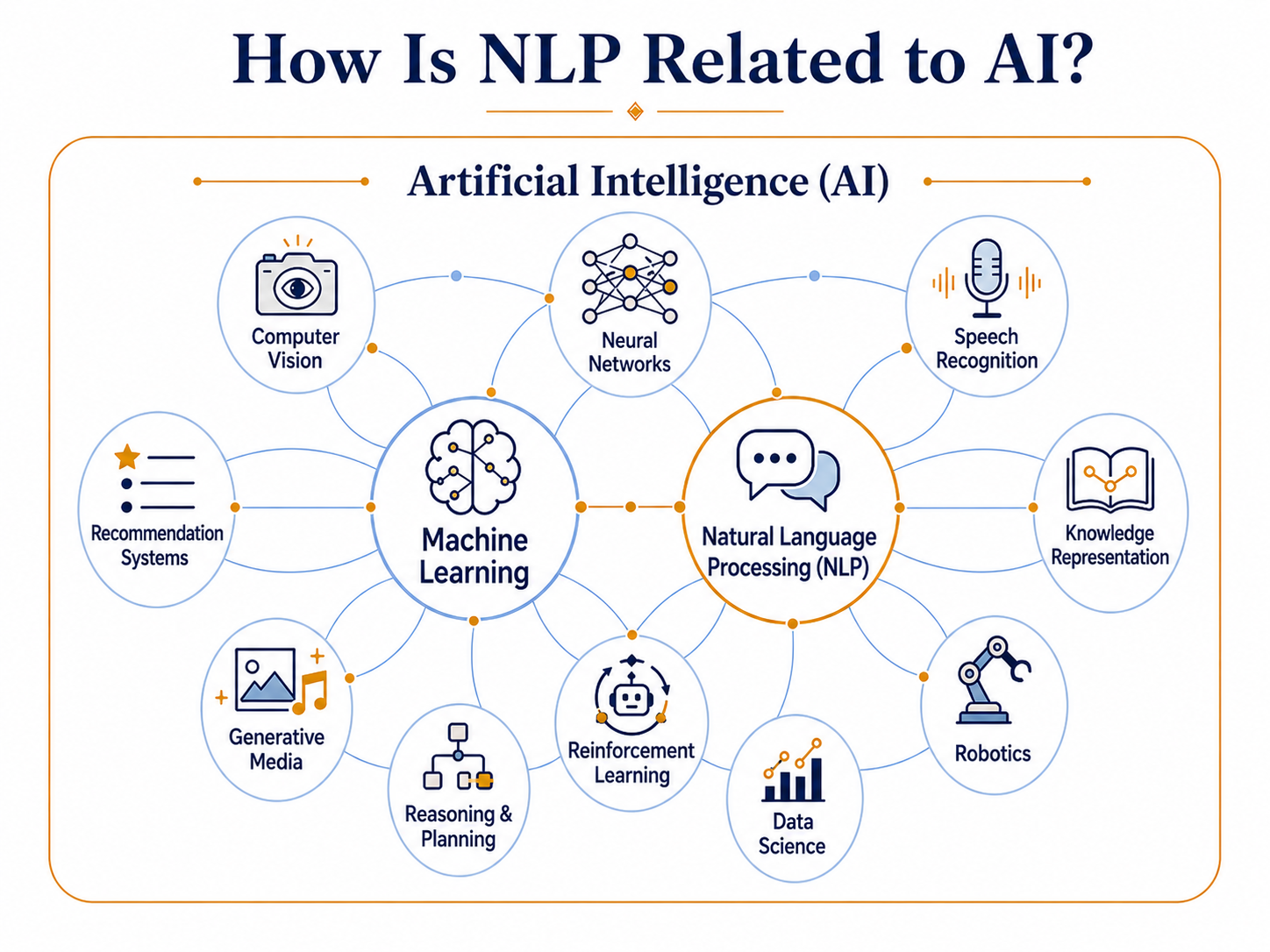
Natural language processing is one part of artificial intelligence, and it now sits near the center of how many people experience AI tools.
One of the questions students are asking right now is also one of the most reasonable.
Should I still study computer science if AI can write code?
I recently wrote a piece for CU Boulder Online about that question, with a focus on artificial intelligence, natural language processing, large language models, and the future of computer science careers.
The short version is that computer science is not disappearing.
The work is changing.
Natural language processing used to feel like a specialized area of artificial intelligence. Now it shows up in chatbots, search engines, coding assistants, summarization tools, translation systems, tutoring tools, workplace automation, and everyday software.
That shift changes what students need to learn.
It does not remove the need for strong foundations. Students still need programming, algorithms, data structures, databases, systems, software engineering, and mathematical reasoning. They also need enough AI literacy to use tools carefully, evaluate outputs, understand limits, and connect technical systems to real problems.
That is especially relevant for post-baccalaureate students. Many students in CU Boulder’s Applied Computer Science Post-Baccalaureate program already bring knowledge from another field. In an AI-shaped software world, that earlier experience can become part of their technical strength.
You can read the full CU Boulder Online article here:
If you are thinking about computer science careers, AI, NLP, and what students should be learning now, these pieces connect closely to this discussion.
]]>Curry GuinnWill AI Replace Software Engineers? The Mistake Behind the Hype2026-05-26T00:00:00+00:002026-05-26T00:00:00+00:00https://curryguinncspb.github.io/ai-didnt-replace-software-engineers
AI can help generate code, but software engineering still depends on architecture, testing, security, and human judgment.
The mistake was believing that writing code was the same thing as software engineering.
That, I think, is the simplest way to answer the question many students are asking right now: will AI replace software engineers?
No. Software engineers are more than code generators.
In 2025, the hype cycle around AI coding tools was enormous. Some executives talked as if software engineers were about to become optional because AI could write code, generate tests, scaffold applications, fix bugs, and work inside an IDE faster than a human could type. Those abilities were real. The conclusion was wrong. Code generation had been confused with software engineering.
In 2026, many companies appear to be rediscovering the difference.
“The model still cannot operate autonomously.” - Marc Benioff, Salesforce CEO
One of the clearest signs of that shift comes from Marc Benioff. Salesforce has been highly visible in the enterprise AI conversation, and Benioff has spoken often about agents, productivity gains, and the changing nature of software work. In late 2024 and 2025, Salesforce also became part of the broader story that AI productivity might reduce the need to keep adding software engineers. That is why his newer comments are so useful.
In an April 2026 interview, Benioff said Salesforce’s roughly 15,000 software engineers had been “hugely augmented” by AI coding tools and agents. His point, however, was almost the opposite of replacement.
“But still, those engineers are needed. The model still cannot operate autonomously. We’re not at that level yet of AI, so it’s really critical, so our engineering organization’s probably 30% more productive, but I wouldn’t call it 100% more productive, and that’s why even in the top AI companies, if you go to their job boards you’ll see they’re hiring a lot of engineers.”
A 30% productivity gain is significant. It means AI can accelerate engineering work and change how teams allocate time. It does not mean companies can replace the people who understand the system, the users, the constraints, and the consequences of getting the software wrong. That is a very different story from saying software engineering jobs are disappearing.
“Programming is not software engineering.” - Mark Russinovich, Scott Hanselman, Microsoft
Mark Russinovich, Microsoft Azure CTO, and Scott Hanselman, VP of Developer Community at Microsoft, put the distinction directly in a 2026 Communications of the ACM article:
“Although AI agents are advancing rapidly, human expertise remains essential in software development. Programming is not software engineering. Even the most reliable systems cannot fully replace the judgment, creativity, and adaptability required to handle uncertainty, make complex decisions, and maintain security. While agents can speed up workflows and reduce manual effort, they lack the intuition to anticipate edge cases and build robust solutions. Relying too much on AI risks missing subtle bugs, architectural flaws, and vulnerabilities only skilled engineers can catch. Human oversight, critical thinking, and domain knowledge are indispensable for both correcting errors and driving innovation as technology progresses.”
Programming is part of software engineering, of course. Code, syntax, and implementation still count. But software engineering also includes understanding the problem, shaping requirements, designing architecture, modeling data, testing, deploying, monitoring, debugging, improving performance, securing systems, managing maintainability, and anticipating the long-term cost of change.
Russinovich and Hanselman describe AI agents that can produce impressive code while making mistakes experienced engineers recognize quickly: masking race conditions, duplicating logic, leaving debugging code behind, implementing hacks that satisfy narrow tests, or declaring success when significant bugs remain. AI-generated code can look finished before the software is actually correct. The real question is whether someone understands the software well enough to trust, reject, revise, test, secure, and maintain what the AI produces.
“The reckless temptation of AI code generation.” - David Linthicum, InfoWorld
This is why AI coding tools can feel magical in small examples and complicated in production. A demo, a prototype, or a small script can be forgiving. Production software has users, old data, edge cases, permissions, dependencies, performance constraints, compliance obligations, security risks, strange workflows, and code shaped by years of history.
“The applications often work, which makes this approach deceptively effective. The demo succeeds, and, at first, the feature seems to function properly. Everyone congratulates themselves. But then the system is deployed at scale and the cloud bill skyrockets. What used to cost $10,000 a month on AWS suddenly jumps to $300,000 or more. In the worst cases, companies face multimillion-dollar monthly cloud costs for systems that should never have been built that way in the first place.
“AI can generate code, but it doesn’t grasp efficiency like experienced engineers do. It doesn’t prioritize cost-efficient architecture. It doesn’t instinctively avoid wasteful service calls, excessive data movement, poor caching, bad concurrency patterns, noisy database behavior, or compute-heavy nonsense that might look good in a code sample but fails in real-world use. It produces something plausible. However, it doesn’t deliver something financially responsible.” - InfoWorld
AI is very good at producing plausible code inside a narrow context. That can be extremely useful for boilerplate, first-pass tests, API examples, framework translation, and getting unstuck. But production code carries history that is rarely visible in a prompt. An ugly function may handle a rare customer case from three years ago. A duplicate-looking validation check may exist because two systems use the same field differently. A complicated database query may be protecting a reporting workflow the obvious version would quietly break. Good engineers learn to ask those questions before they “clean up” code that already carries production history.
AI makes syntax cheaper. It makes judgment more valuable.
“Programming is writing code. You take an idea and translate it into syntax that the compiler accepts. Software engineering is much more. It is the work of building software that works in the real world and keeps working for years. It includes programming, but also understanding the problem, writing the requirements, designing the system, choosing the right abstractions, testing, deployment, monitoring, security, and talking with stakeholders.
….
AI tools are very good at the first part. They write code. They do not do the second part.” - Simon Martinelli
There is a useful way to think about what AI coding tools are doing: they are making syntax cheaper. When code is cheaper to produce, more people can experiment, developers can move faster, students can test ideas more quickly, and teams can automate tedious work. That is real progress, and students should learn to use these tools well.
The harder questions move into the foreground. If AI can generate five possible implementations in a few seconds, which one fits the architecture? Which one handles the edge cases? Which one is secure? Which one will still make sense to the next developer? Which one should not be built at all? A student who understands algorithms, data structures, databases, computer systems, testing, security, and software design can evaluate AI output more carefully. A student whose only skill is asking an AI for code may get something that runs without having a reliable way to judge whether it is good software.
“We are going to need tons and tons of software developers who know how to build systems, who know how to think about solving problems for customers.” - Matt Garman, CEO, Amazon Web Services, May 20, 2026
The future, in Matt Garman’s view, is about engineers who can build systems and solve problems for customers. If your only skill is producing syntax, AI is a direct threat. If your skill is understanding systems, customers, tradeoffs, data, reliability, and architecture, AI becomes a tool inside a larger engineering process.
Students should learn AI coding tools as accelerators inside that larger craft. The goal is to become the person who can decide what should be built, how it should work, whether the generated code is trustworthy, and how the whole system will survive contact with real users.
“We’re at a beginning, not an end, of software development.” - Eira May, Stack Overflow blog
“We’re at a beginning, not an end, of software development. As our [Stack Overflow] CEO put it, ‘There’s literally an infinite number of things to build.’ That’s what we’re excited about: The scale and ambition of what we can build is soaring. Barriers to entry have fallen; imagination has become reality. Developers can meet the moment just as they met historical platform shifts, from the internet to cloud computing and the rise of SaaS to mobile-first development. There’s so much more to build. Let’s get to work. “ - Eira May, Stack Overflow, quoting CEO Prashanth Chandrasekar.
“Cloud computing didn’t lead companies to need less compute. It made them build more things that consumed compute. AI-assisted coding may be doing something similar for software itself.” - Matt Asay, InfoWorld
That pattern should sound familiar. When cloud computing made computing resources easier to use, companies built more software that used more compute. When high-level programming languages made software easier to write, the world built more software. AI may follow a similar pattern. If software becomes easier to produce, companies may automate more workflows, create more internal tools, modernize more legacy systems, and build more AI-enabled products that previously sat in the backlog.
What this means for computer science students
For current and prospective computer science students, the takeaway is straightforward. Learn the AI tools, because they are becoming part of professional software development. But treat them as accelerators, not replacements for the foundations: algorithms, systems, databases, networks, APIs, testing, security, and deployment.
So should students still study computer science if AI can write code? My answer is yes, but they should study it with AI in view.
That is especially relevant for post-baccalaureate students. Many CSPB students come to computer science with another degree, another profession, or another way of understanding the world. In the AI era, that prior background may become part of the advantage. The strongest future developers may be people who understand computing and something else.
Programming After Programmers
A response to the New York Times Magazine article on AI and coding, with a focus on why systems thinking and domain knowledge remain central.
What You Learn in Computer Science
An overview of the core ideas behind software systems, and why those ideas remain central in an AI-heavy environment.
]]>Curry GuinnCSPB Career Changers: How Alumni Move Into Computing2026-04-26T00:00:00+00:002026-04-26T00:00:00+00:00https://curryguinncspb.github.io/cspb-alumni-career-changesOne of the most important questions for prospective CSPB students is not just where alumni end up.
It is where they started.
CSPB is CU Boulder’s online post-baccalaureate B.S. in Applied Computer Science. Many students enter the program after already completing a first degree and spending time in another field. So the career-change question matters.
Are alumni mostly people who were already in computing?
Or are many of them using CSPB to move into CS from somewhere else?
This LinkedIn-based review is not official CU Boulder placement data. It is a hand-reviewed snapshot based on visible LinkedIn education and work-history information, so it has the usual limitations. Some profiles are incomplete. Some are out of date. Some do not give enough detail to classify confidently.
But the pattern is still useful.
I looked at broader CSPB alumni outcomes in a separate post, including current roles, industries, employers, and geography; this post focuses more specifically on career changers and the paths alumni took into computing: CU Boulder CSPB Alumni Outcomes.
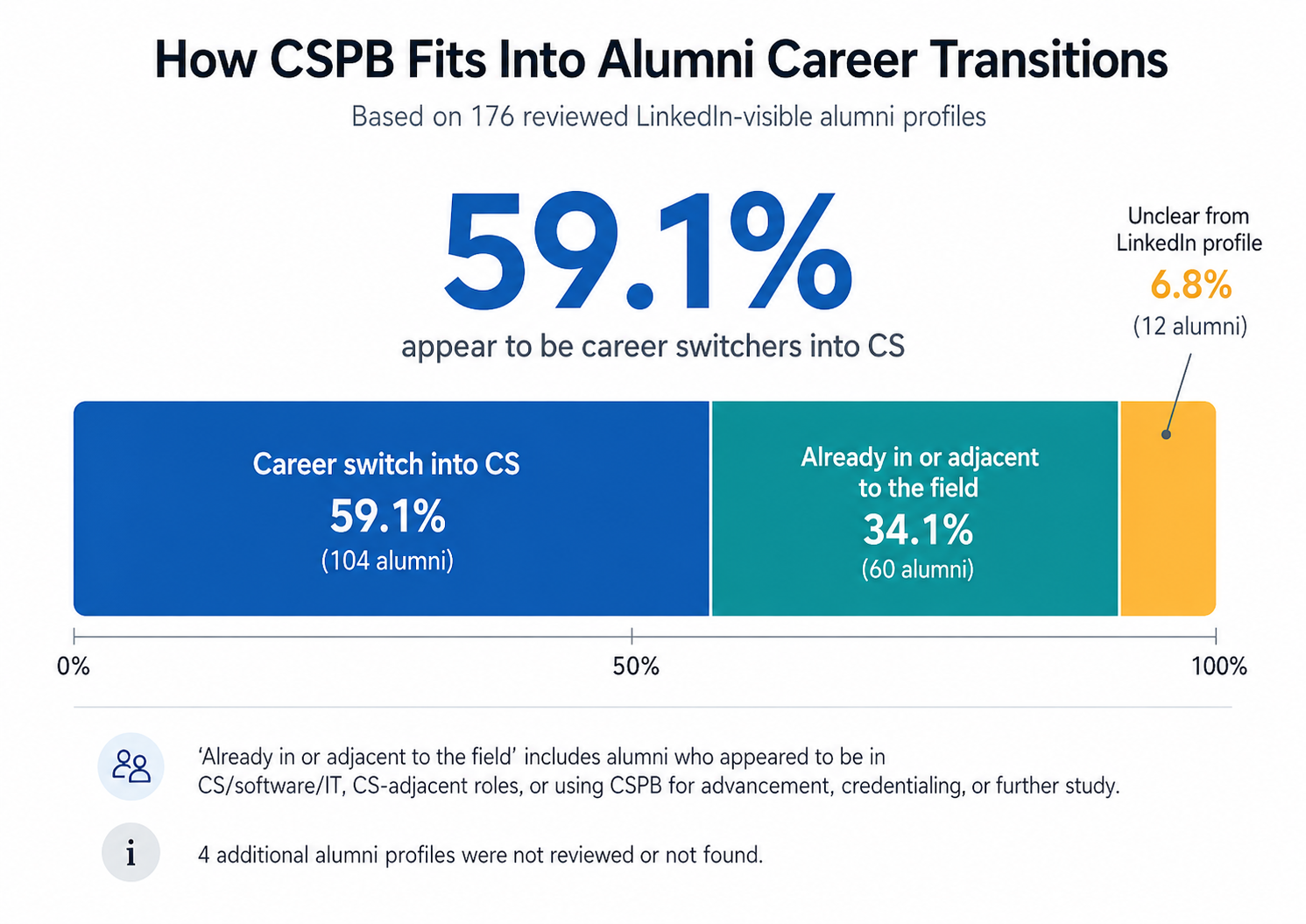
“About 6 in 10 reviewed alumni appear to be career switchers into CS.”
Career-switch categories were standardized from reviewed LinkedIn-visible education and work histories.
The clearest career-change finding is that 104 of the 176 reviewed LinkedIn profiles appear to represent clear or likely career switches into CS.
That is 59.1% of the reviewed profiles.
Another 60 alumni, or 34.1%, appear to have already been in or adjacent to the field. That includes people who were already in CS, software, IT, CS-adjacent roles, or using CSPB for advancement, credentialing, or further study.
The remaining 12 profiles, or 6.8%, did not provide enough LinkedIn-visible evidence to classify confidently.
So the cautious version is this: in this LinkedIn-based review, about 6 in 10 reviewed alumni appear to be career switchers into CS.
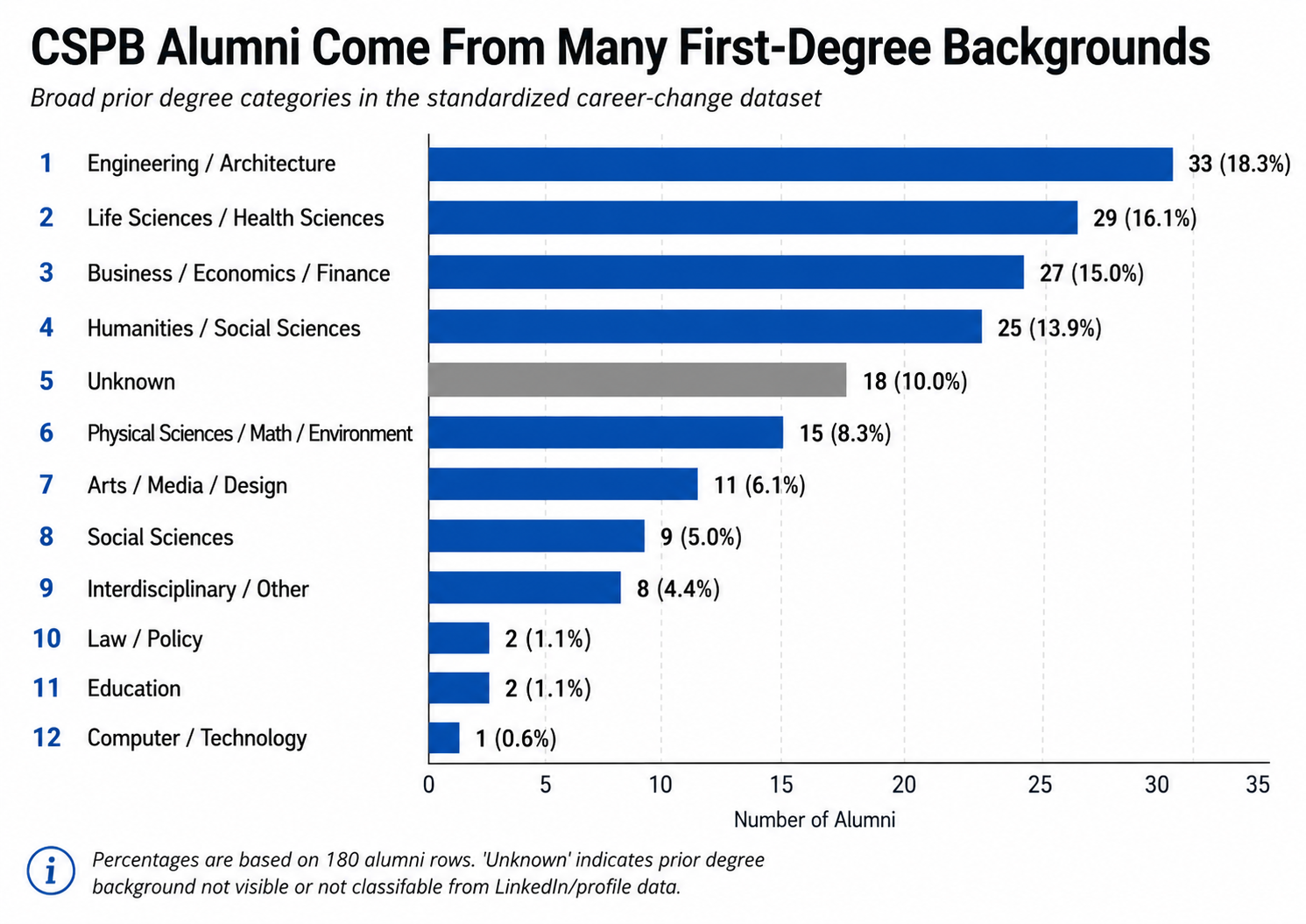
“CSPB alumni come from many first-degree backgrounds.”
Prior degree categories were standardized from LinkedIn-visible education histories and profile information.
One of the things I find most interesting about CSPB is that students do not arrive from one academic background.
The largest prior-degree category in the dataset is engineering and architecture, but that category represents only 18.3% of alumni rows. Life sciences and health sciences account for 16.1%. Business, economics, and finance account for 15.0%. Humanities and social sciences account for 13.9%.
So there is no single dominant prior academic path into CSPB.
That matters because a post-baccalaureate program is not the same thing as a traditional undergraduate computer science major. Many students arrive with a first degree, prior work experience, and a different way of thinking about problems.
The data suggests that CSPB is serving students who are using computer science as a second layer: a way to redirect a career, deepen a technical path, or combine computing with another domain.
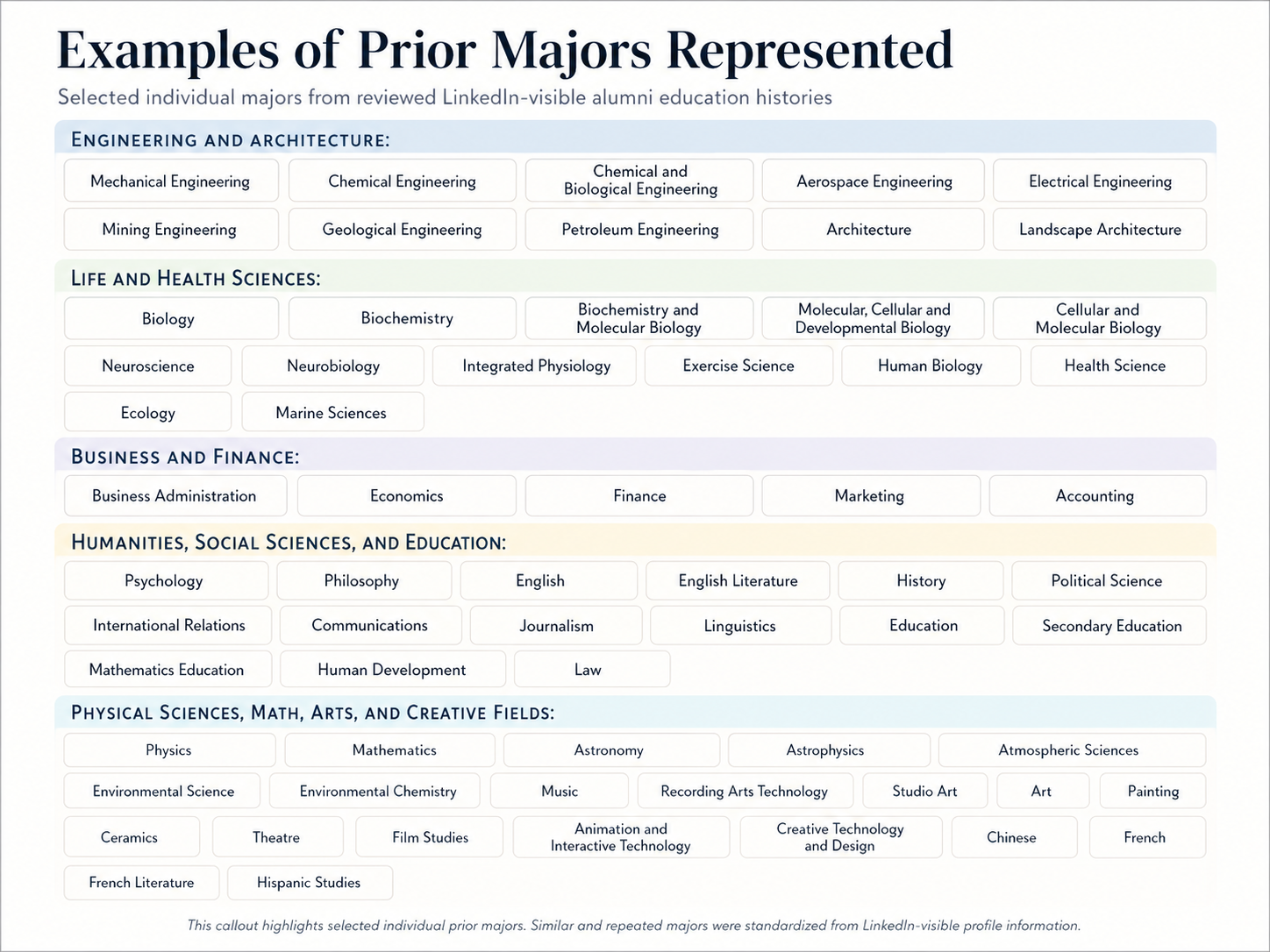
“The individual majors make the range even clearer.”
This callout highlights selected individual prior majors from reviewed LinkedIn-visible education histories.
The broad categories are useful, but the individual majors make the point more concrete.
The reviewed profiles include alumni with prior backgrounds in engineering, biology, finance, psychology, philosophy, music, English, journalism, law, physics, architecture, environmental science, studio art, and many other fields.
That is a useful reminder for prospective students.
A prior degree outside CS does not mean someone is out of place in a computer science program. In many cases, that earlier background becomes part of the student’s eventual technical identity.
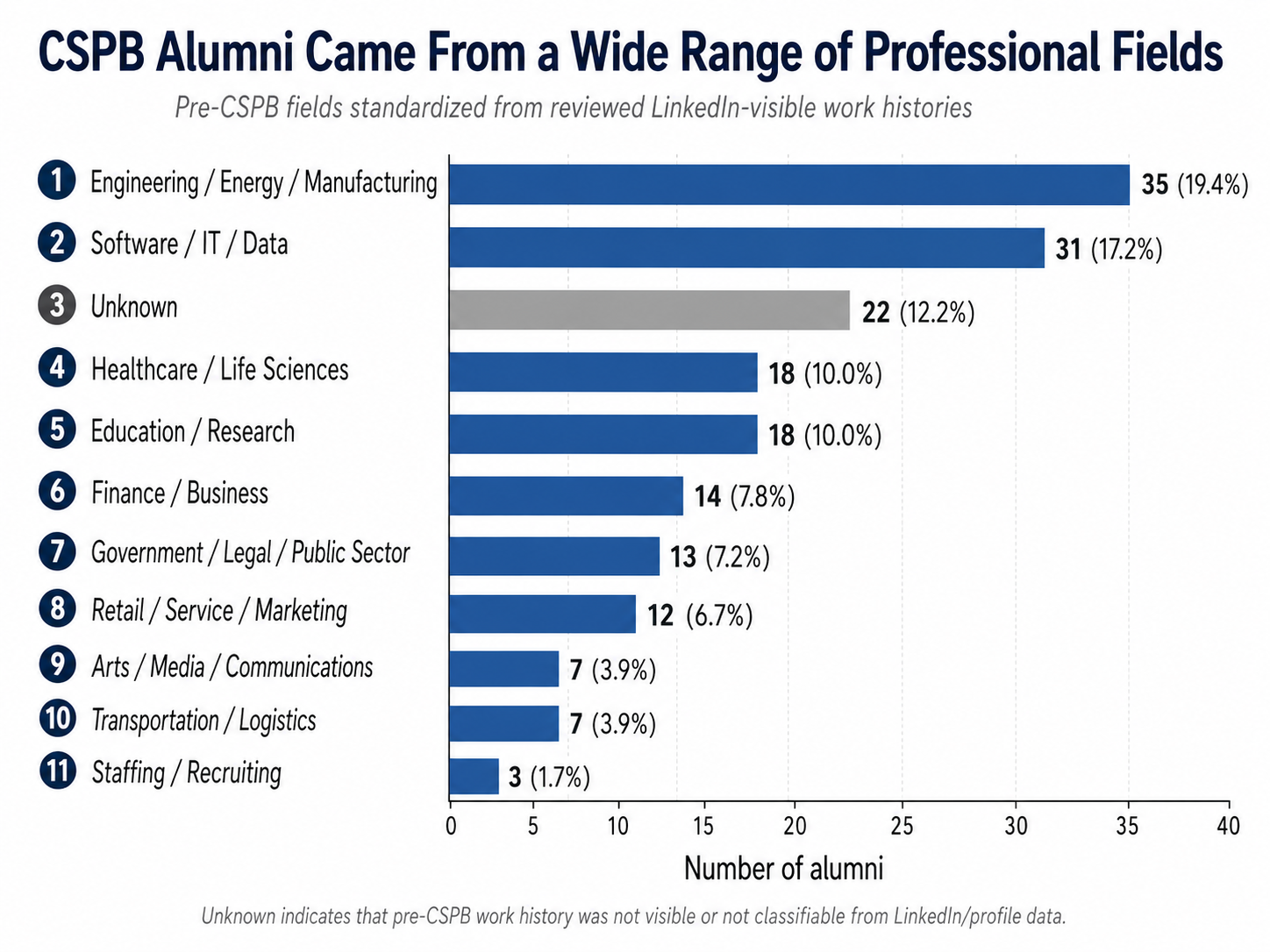
“CSPB alumni also came from many different professional fields.”
Pre-CSPB fields were standardized from reviewed LinkedIn-visible work histories.
This chart looks at prior work, not just prior degrees.
The largest pre-CSPB category in the reviewed dataset is engineering, energy, and manufacturing, followed by software, IT, and data. After that come healthcare and life sciences, education and research, finance and business, government and public-sector work, retail and marketing, arts and media, transportation and logistics, and recruiting.
So the pattern is broad. CSPB students were not all coming from the same professional world before the program.
That helps explain the career-switch story. Some alumni were already in technical roles. Others were working in fields that were only loosely connected to computing. Still others appear to have been making a much more substantial shift.
In other words, many students seem to bring prior domain experience with them, then use computer science to redirect or extend that experience.
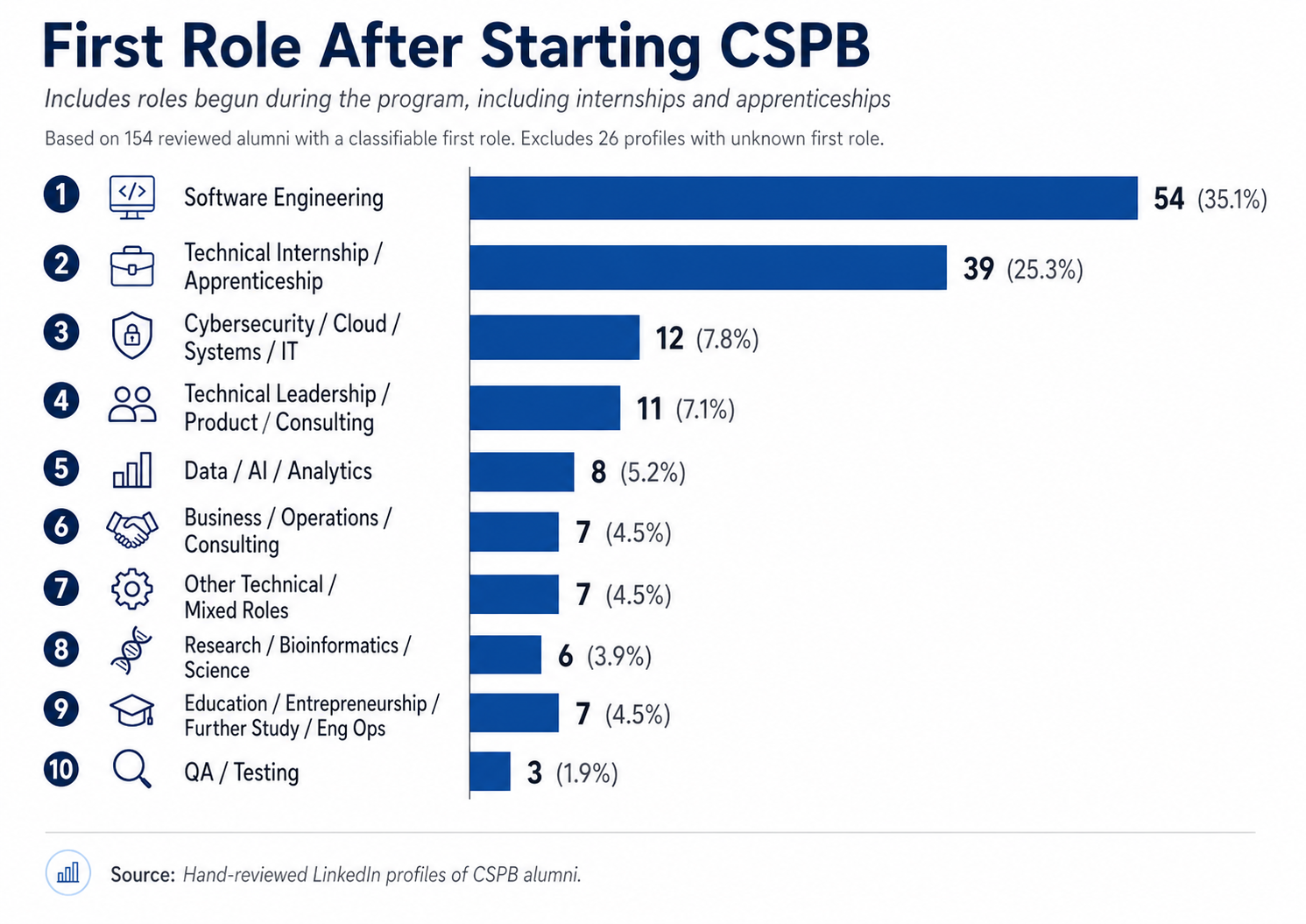
“The first visible step into computing is often software, an internship, or an apprenticeship.”
First-role categories were standardized from reviewed LinkedIn-visible work histories. This chart includes roles begun during the program, including internships and apprenticeships.
This chart asks what alumni first moved into after starting CSPB, whether during the program or after graduation.
That distinction matters because, for many career changers, the first visible bridge into the field is an internship or apprenticeship rather than a full-time role after graduation.
Among the 154 reviewed alumni with a classifiable first role, software engineering is the largest category at 35.1%. Technical internships and apprenticeships are next at 25.3%.
That is an important result. It suggests that CSPB often functions as a bridge into computing. For many students, the transition shows up first in an internship, apprenticeship, or early technical role, not just in a later full-time job title.
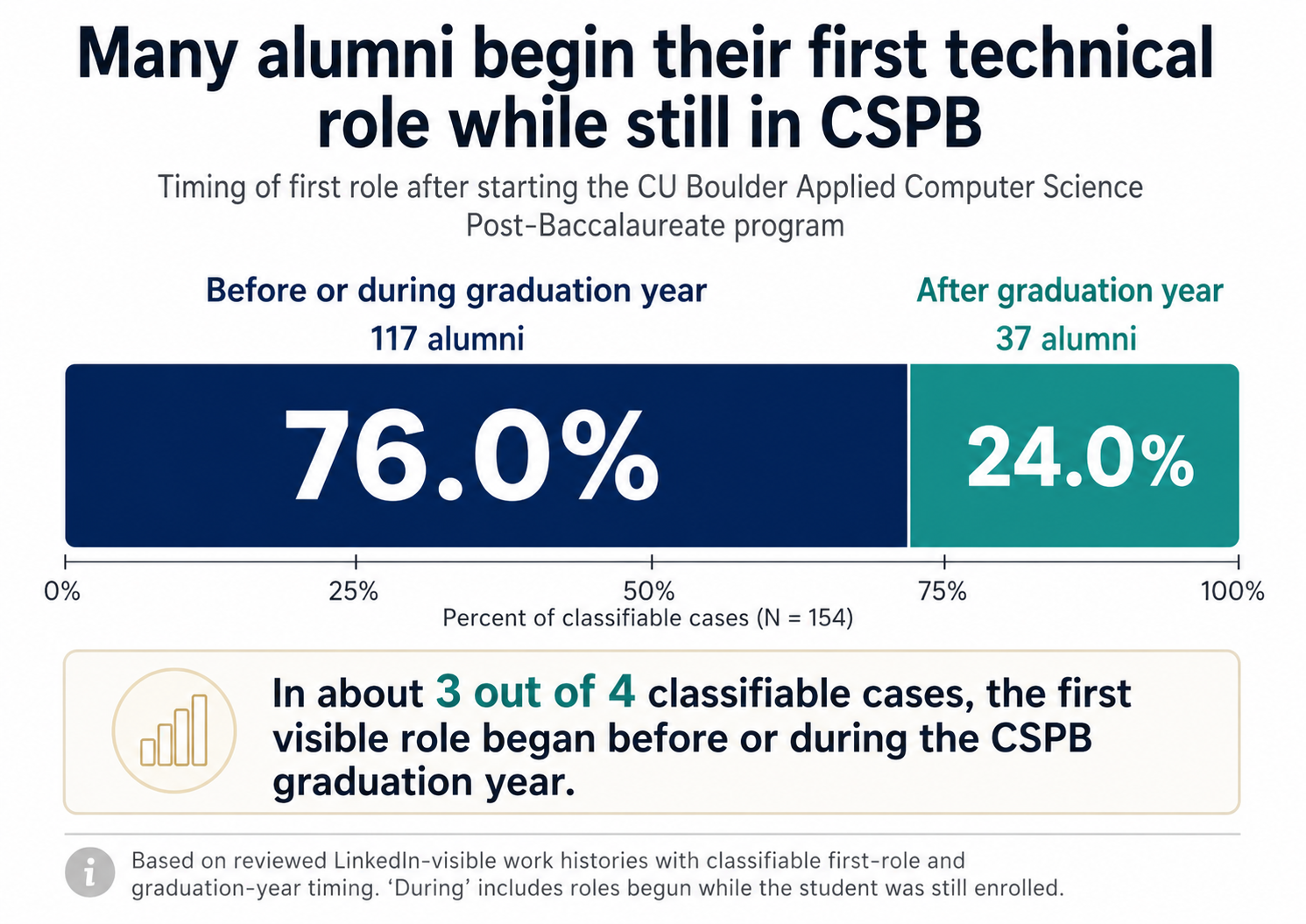
“For many alumni, that first role begins before graduation.”
Timing is based on reviewed LinkedIn-visible work histories with classifiable first-role and graduation-year information.
This chart shows when alumni began their first visible technical role after starting CSPB.
In classifiable cases, 76.0% began that first role before or during the CSPB graduation year, while 24.0% began after graduation.
That is an important reminder that, because the program is online and asynchronous, many students are able to begin internships or technical roles while still completing the degree.
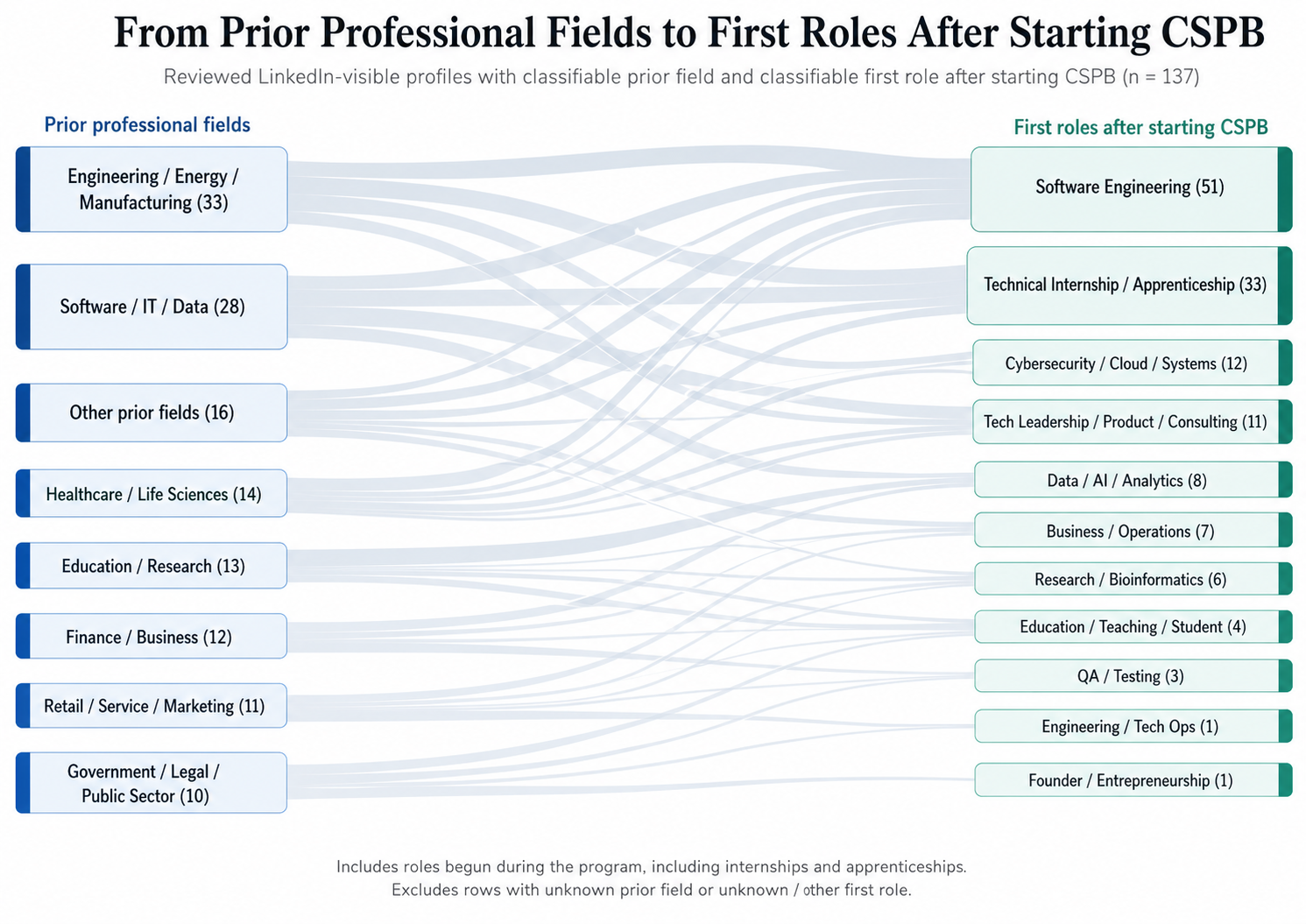
“The transition into computing does not happen in just one way.”
Flows are based on reviewed LinkedIn-visible work histories. This chart includes first roles begun during the program, including internships and apprenticeships.
This chart connects alumni’s prior professional fields to their first visible roles after starting CSPB.
What stands out is movement across many different paths. Alumni came from engineering, healthcare, education, finance, government, retail, and other fields, then moved into software engineering, internships, cybersecurity, data, research, consulting, and other technical roles.
The two largest first-role destinations are software engineering and technical internships or apprenticeships. That suggests that, for many students, the transition into computing begins during the program rather than only after graduation.
So the story here is not one pipeline or one destination.
It is multiple routes into computing.
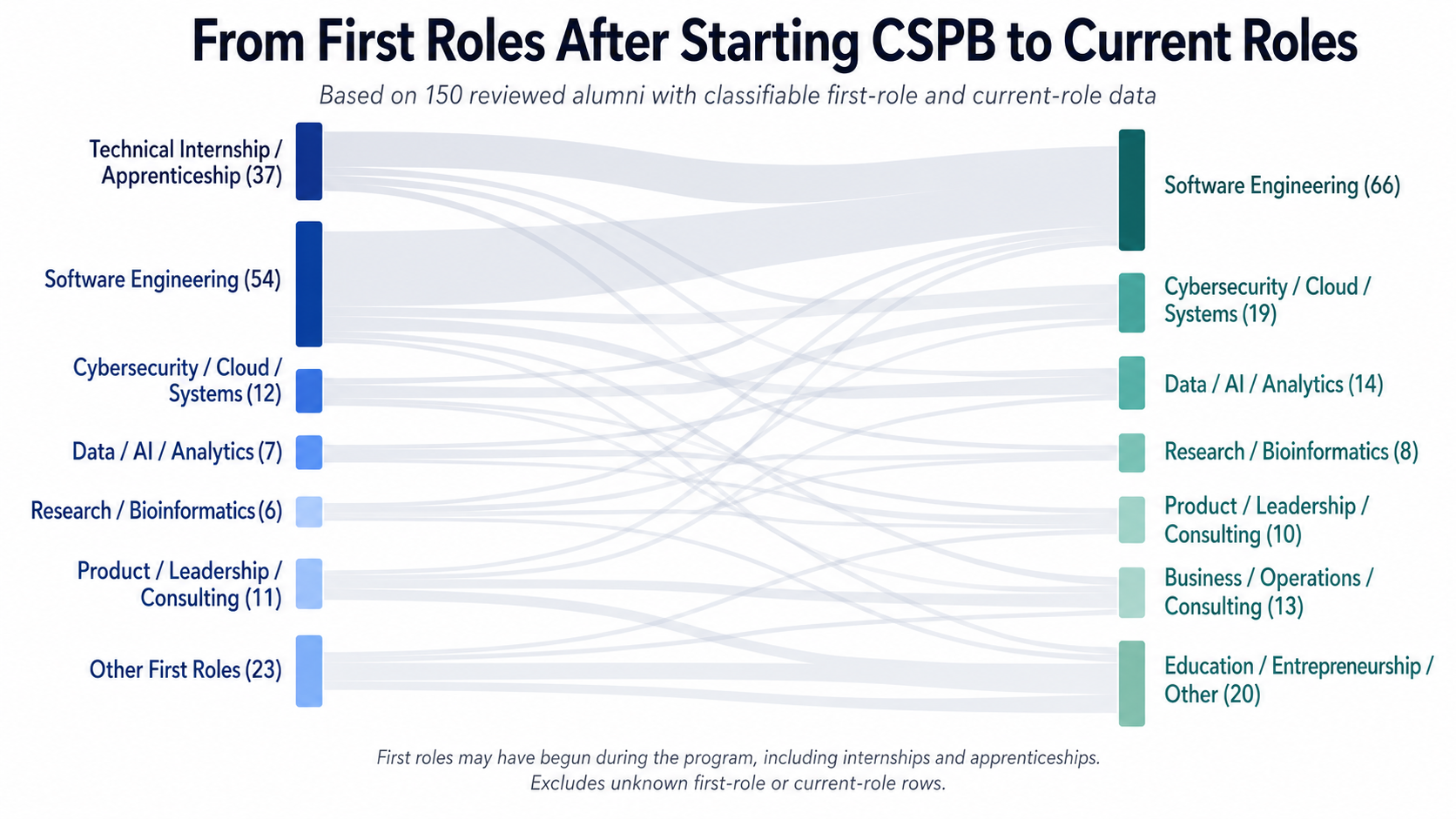
“The first foothold in computing is often not the final destination.”
Based on reviewed LinkedIn-visible work histories. Excludes rows with unknown first-role or current-role data.
This chart shows how first roles after starting CSPB connect to current roles.
The main pattern is progression. Many alumni begin in internships, apprenticeships, or other early technical roles, then move into software engineering and other established technical paths.
The first foothold in computing is often a bridge, not the endpoint.
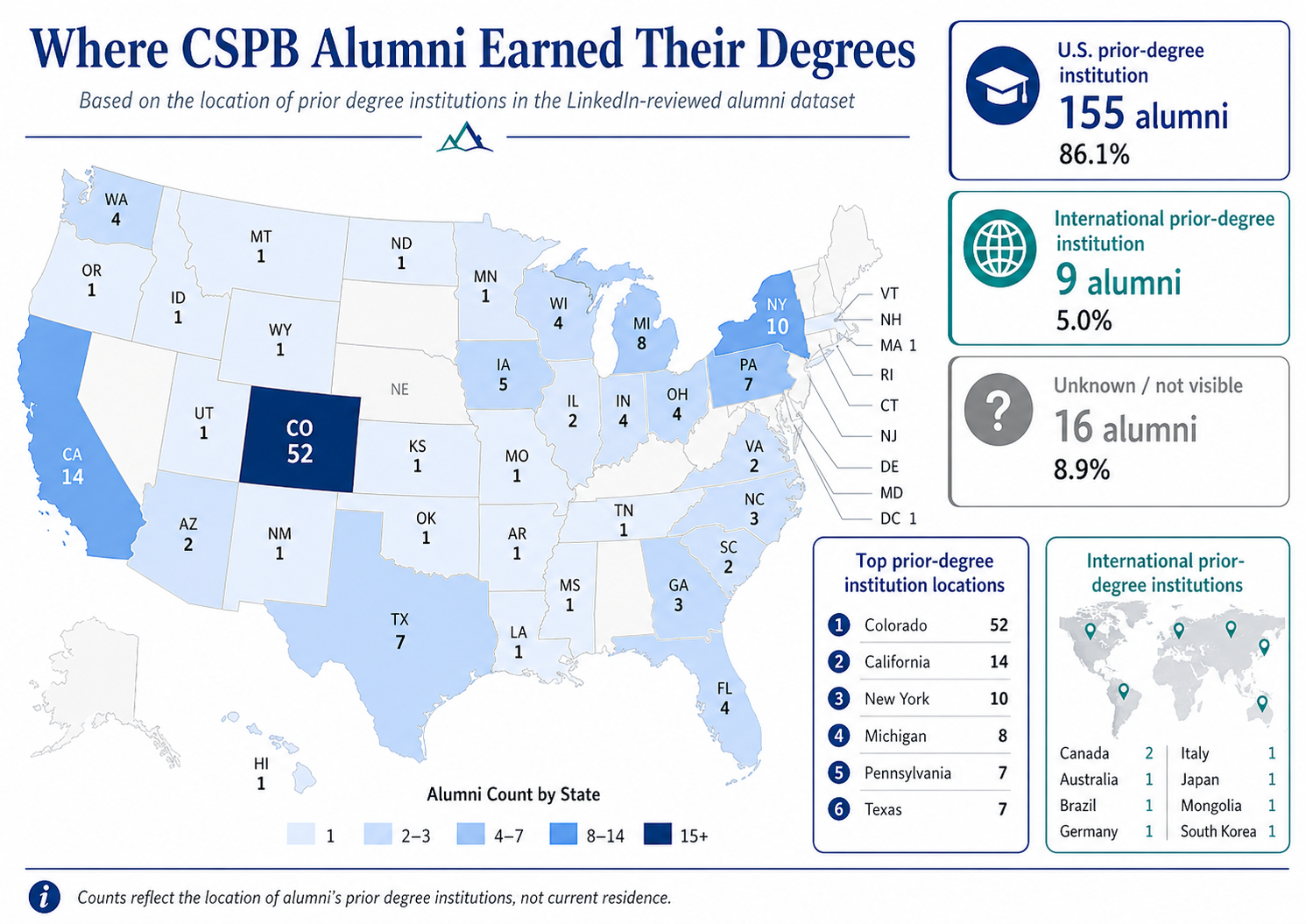
“CSPB alumni earned prior degrees across many states and countries.”
Prior degree institution locations are based on reviewed LinkedIn-visible education histories.
CSPB alumni did not all come from one place before entering the program.
Colorado is the largest single source of prior-degree institutions, but the broader pattern is geographic diversity, with prior degrees spread across many U.S. states and a smaller set of international institutions.
That fits the shape of the program. CSPB has a strong Colorado identity, but it also serves students with varied educational backgrounds from well beyond Colorado.
“The data is useful, but it has limits.”
This is not official university placement data.
It is a hand-reviewed LinkedIn snapshot. It depends on whether alumni had visible profiles, whether those profiles were current, and whether education and work histories were detailed enough to classify.
There was also judgment involved. Prior degrees had to be standardized. Employers and roles had to be interpreted. Some career switches were clear. Others were likely but not certain. A small number remained unclear.
So I would not use this dataset to make overly precise claims.
But I do think it is strong enough to show a useful pattern.
Many CSPB alumni appear to be true career changers. They came from many academic and professional backgrounds. Many began their first technical roles while still in the program. And those first roles often became bridges into later software, systems, data, research, consulting, and other technical paths.
That is the larger story.
CSPB is not just serving one kind of student or producing one kind of outcome.
It is helping students bring prior experience into computing.
]]>Curry GuinnCU Boulder CSPB Alumni Outcomes: Where Applied Computer Science Graduates Work2026-04-25T00:00:00+00:002026-04-26T00:00:00+00:00https://curryguinncspb.github.io/cspb-alumni-outcomes-linkedin-analysis
A LinkedIn-based review of CSPB alumni who graduated in May 2025 or earlier.
One of the questions I hear most often from prospective students is also one of the most reasonable.
Where do graduates of the CU Boulder Applied Computer Science Post-Baccalaureate (CSPB) program actually end up?
That question feels especially important right now. AI is changing software work, the tech job market has cooled, and entry-level hiring has felt harder than it did during the peak hiring years.
So I wanted to look at something concrete.
I reviewed LinkedIn-visible outcomes for CSPB alumni who graduated in May 2025 or earlier. For readers new to the acronym, CSPB is CU Boulder’s online post-baccalaureate B.S. in Applied Computer Science.
This is not an official placement report. It is not a university employment survey. It is a hand-collected LinkedIn snapshot.
But I do think it is useful.
I also wrote a companion post focused specifically on career changers: where CSPB alumni came from before the program, how many appear to have moved into CS from another field, and what their first technical roles looked like after starting CSPB: CSPB Career Changers.
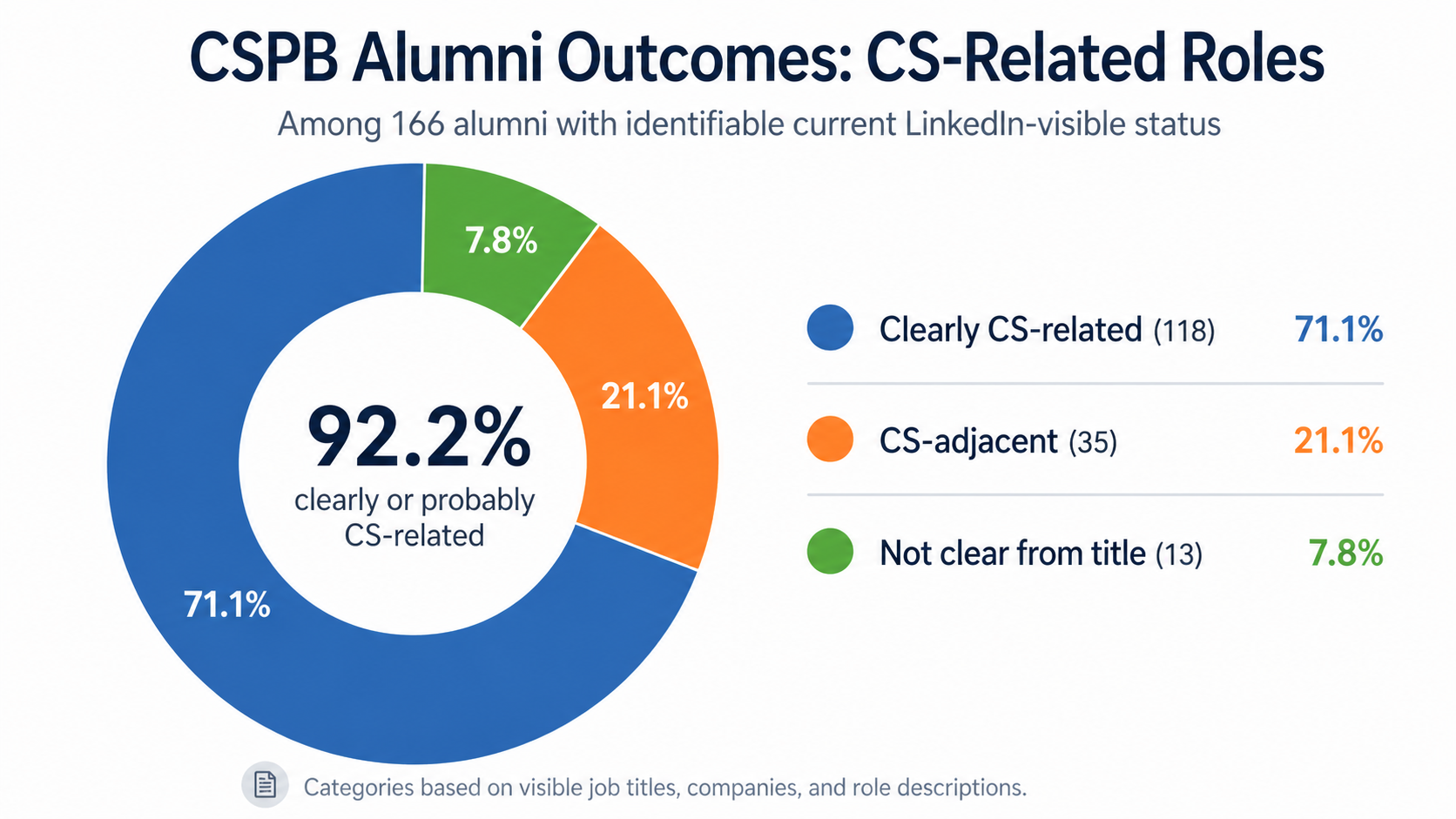
“More than 9 in 10 LinkedIn-visible CSPB alumni are in CS-related or CS-adjacent roles.”
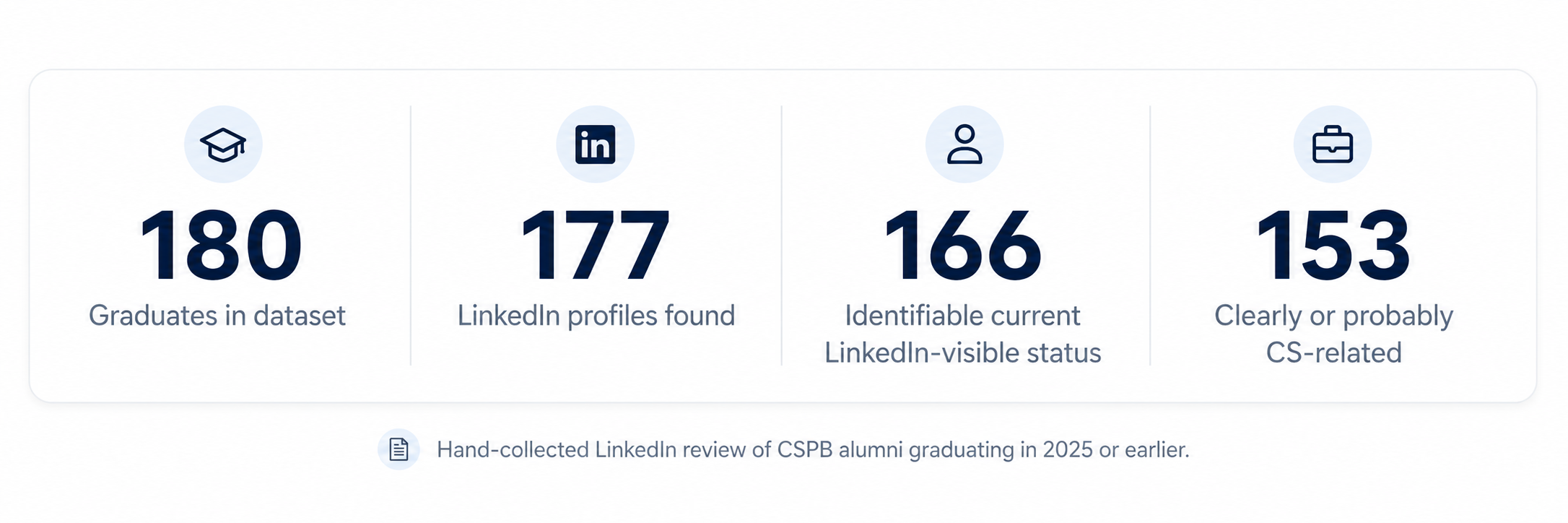
Among alumni with identifiable current LinkedIn-visible status, 153 of 166 were in clearly or probably CS-related roles.
The strongest finding is also the simplest.
Among the 166 alumni whose current LinkedIn-visible status could be identified, 153 were in clearly or probably CS-related roles.
That is 92.2%.
I would not overstate this. LinkedIn data is imperfect, and job titles do not always tell the full story of what someone does. But even with those caveats, the pattern is clear.
Most identifiable CSPB alumni outcomes in this dataset are connected to computing.
That includes software engineering, data and analytics, AI and machine learning, cybersecurity, cloud and systems work, technical operations, research computing, bioinformatics, QA and testing, technical leadership, consulting, founder roles, and student pathways.
Computer science outcomes are broader than one job title.
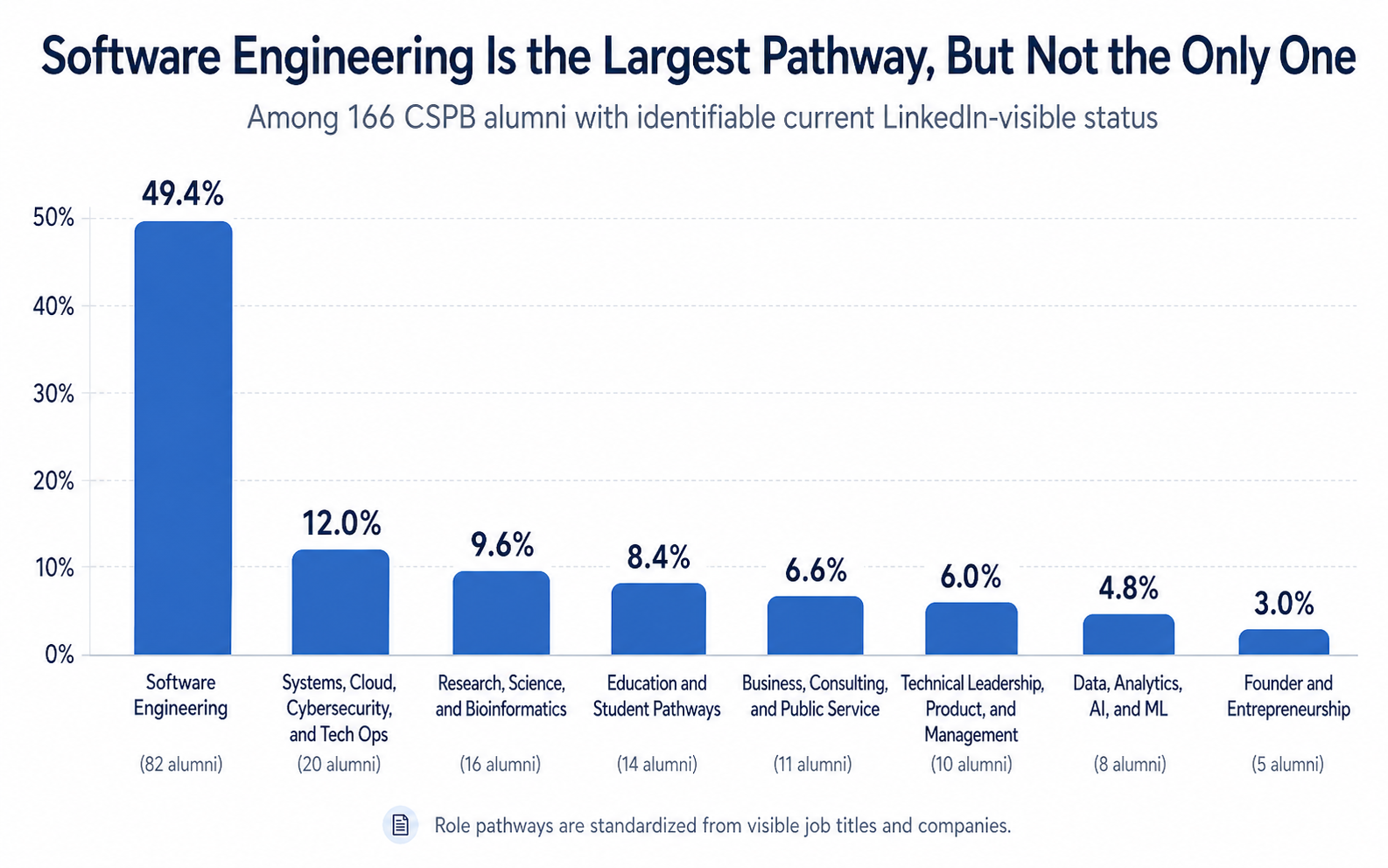
“Software engineering is the largest CSPB alumni career pathway. It is not the only one.”
Role pathways were standardized from visible job titles and companies.
Software engineering is the largest single pathway in the dataset.
Of the 166 alumni with identifiable current LinkedIn-visible status, 82 are in software engineering roles or roles close enough to software engineering to place them in that pathway.
That is 49.4%.
But the more interesting part is the other half of the chart.
CSPB alumni also appear in systems, cloud, cybersecurity, technical operations, research, bioinformatics, education, student pathways, business, consulting, public service, technical leadership, data, AI, machine learning, and entrepreneurship.
That spread matters because CSPB is a post-baccalaureate program. Many students already have a first degree. Some are changing careers entirely. Others are adding computing to work they already know.
Software engineering is the largest destination, but the broader story is that alumni are using computer science in many different ways.
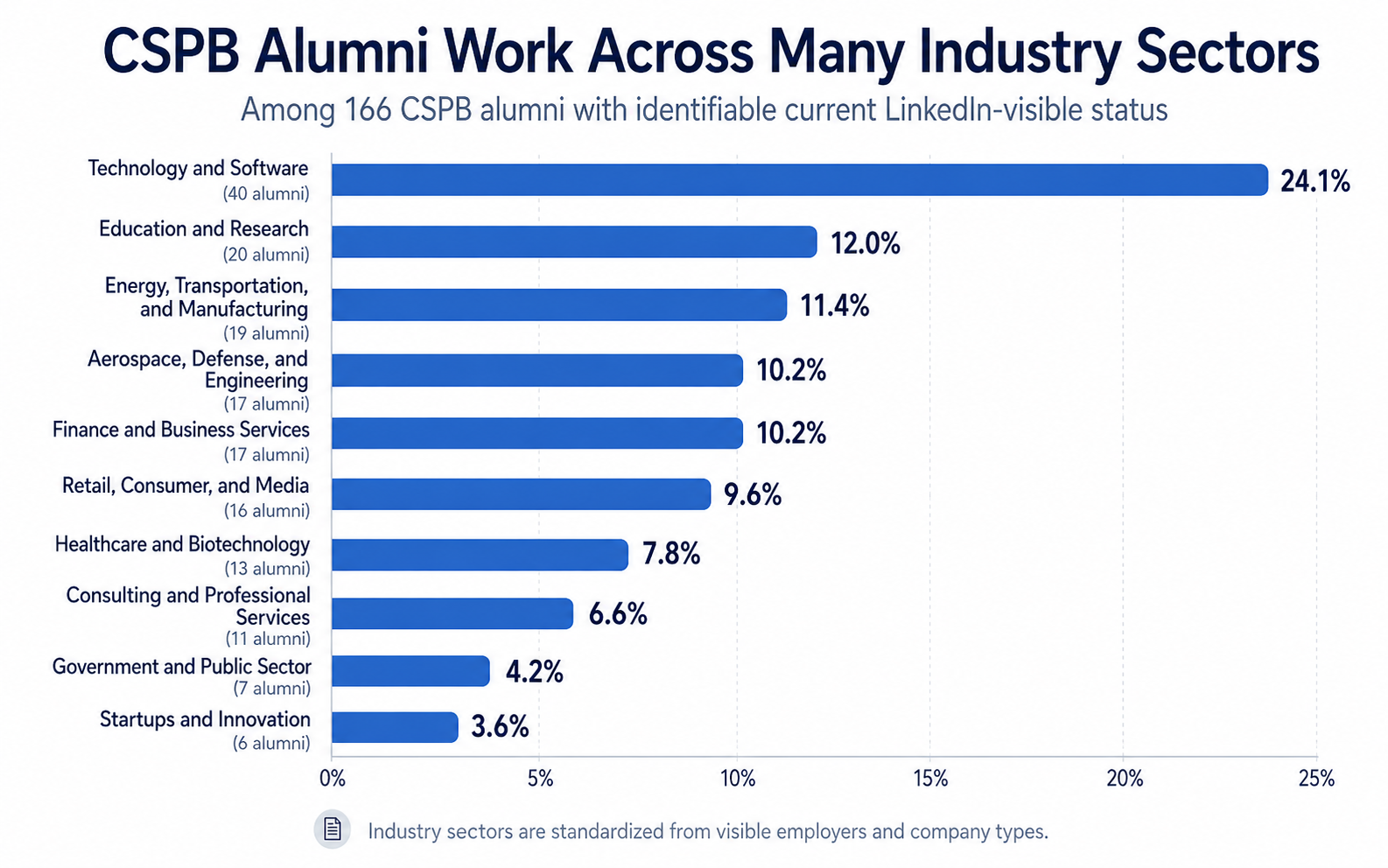
“Computing careers are not confined to the tech industry.”
Industry sectors were standardized from visible employers and company types.
The largest industry sector in the dataset is technology and software.
But it is not the majority.
Technology and software accounts for 40 of the 166 identifiable outcomes, or 24.1%. That means roughly three-quarters of the identifiable alumni outcomes are outside the traditional technology and software sector.
To me, that is one of the most important things in the data.
CSPB alumni appear in education and research, energy, transportation, manufacturing, aerospace, defense, finance, business services, retail, media, healthcare, biotechnology, consulting, government, public sector work, startups, and innovation environments.
That is a useful correction to the way people sometimes talk about computer science. When the tech industry has a difficult year, it is easy to assume that computer science itself has weakened as a path. But computing skills are not confined to technology companies.
Software, data, systems, and computational thinking continue to show up across the economy.
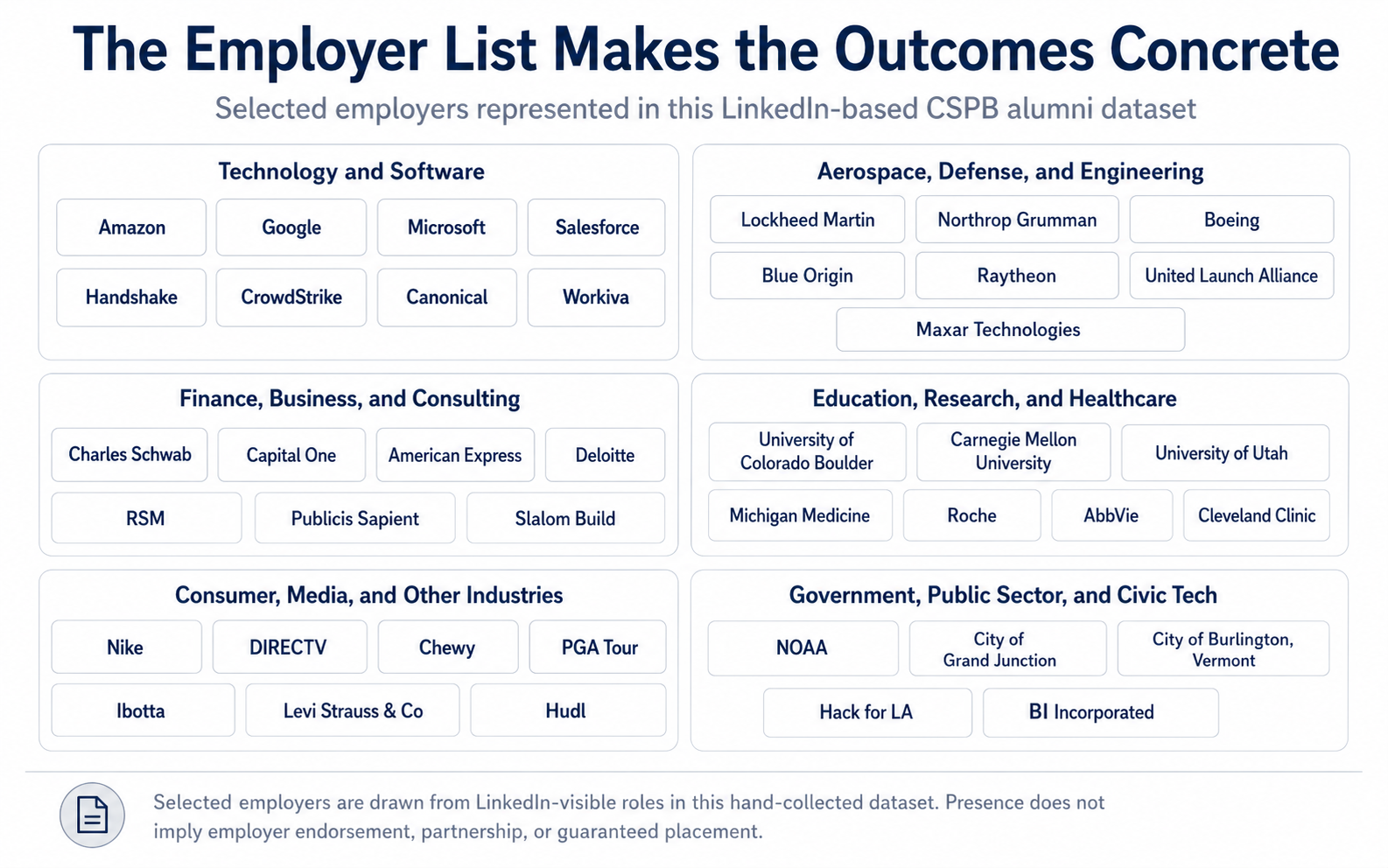
“CSPB alumni employers make the outcomes concrete.”
Selected employers are drawn from LinkedIn-visible roles in this hand-collected dataset. Presence does not imply employer endorsement, partnership, or guaranteed placement.
Percentages are useful, but employer names make the picture more concrete.
The employer list in this dataset includes large technology companies, aerospace and defense organizations, universities, research institutions, healthcare organizations, finance firms, consulting firms, public-sector employers, consumer companies, media organizations, and startups.
I want to be careful about how to present that.
This is not a list of official hiring partners. It does not imply endorsement, guaranteed placement, or direct recruiting from the program.
It simply means that alumni in this LinkedIn-based dataset list roles at these organizations.
That is still useful. For prospective students, employer names help translate abstract categories into something more understandable.
The point is not prestige for its own sake.
The point is range.
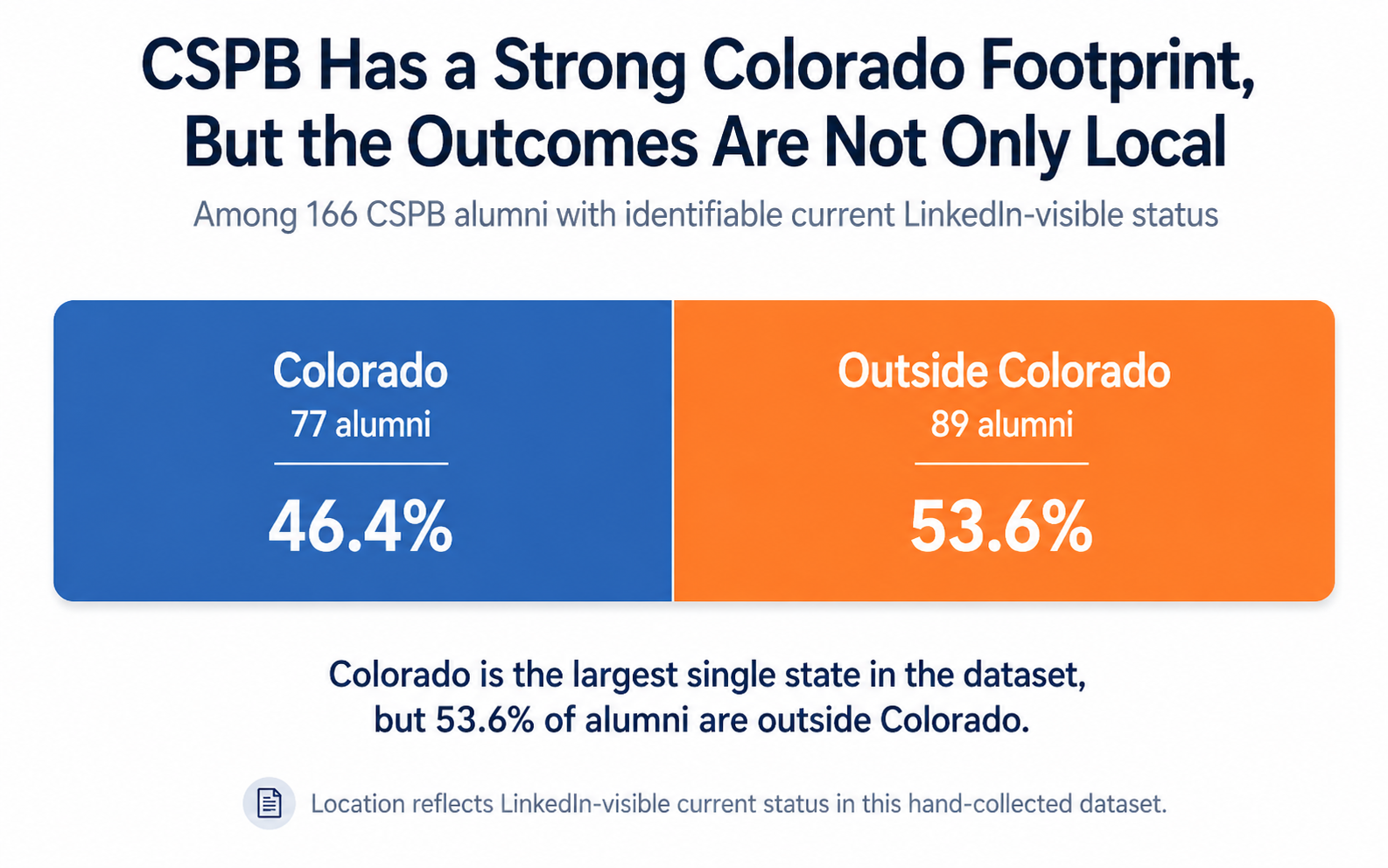
“CSPB has a strong Colorado footprint, but the outcomes are not only local.”
Location reflects LinkedIn-visible current status in this hand-collected dataset.
The program has a strong Colorado footprint.
That makes sense. CSPB is a CU Boulder program, and many students and alumni remain connected to the region.
But the outcomes are not only local.
Of the 166 alumni with identifiable current LinkedIn-visible status, 77 are in Colorado and 89 are outside Colorado. That means 46.4% are in Colorado and 53.6% are outside Colorado.
That seems important for an online post-baccalaureate program. CSPB has a strong Colorado identity, but it also serves students who are building careers in many different places.
“This is a LinkedIn-based snapshot, not an official placement report.”
I want to be clear about 2020 limits of this analysis.
This is not official university placement data. It is a hand-collected LinkedIn review of CSPB alumni who graduated in May 2025 or earlier.
That means it depends on whether alumni had LinkedIn profiles, whether those profiles were findable, and whether the profiles appeared current enough to classify.
There was also judgment involved. Job titles had to be standardized. Company names had to be cleaned. Industry sectors had to be assigned. Some roles were clearly CS-related. Others were more adjacent.
So I would not use this dataset to make overly precise claims.
But I do think it is strong enough to show a pattern.
Final thought
The current conversation around computer science can be discouraging.
Students hear that the market is difficult, that AI is changing software work, and that entry-level roles are more competitive than they used to be.
Some of that concern is justified.
But the alumni data here points to a more balanced story.
CSPB graduates are showing up in CS-related and CS-adjacent roles across a wide range of industries and employers.
That does not mean the path is automatic. Students still need to build strong projects, learn the fundamentals, practice technical communication, prepare for interviews, and keep adapting as the field changes.
But the data does suggest that the degree is connecting to real technical outcomes.
The story here is not that every graduate follows the same route.
The story is that computer science opens several routes.
Software engineering is the largest one.
It is not the only one.
Related Articles
If you are thinking about computer science careers, AI, and whether CS remains a strong path, these pieces connect closely to this discussion.
CU Boulder CSPB Alumni Career Changes
A broader LinkedIn-based look at prior degrees, previous fields, first technical roles, and career movement among CU Boulder Applied Computer Science post-bacc alumni.
Is Computer Science Dead in 2026?
A broader look at the headlines around AI and computer science jobs, and why the simple collapse story does not hold up very well.
Programming After Programmers
A response to the New York Times Magazine article on AI and coding, with a focus on why systems thinking and domain knowledge still matter.
What You Learn in Computer Science
An overview of the core ideas behind software systems, and why those ideas still matter in an AI-heavy environment.
]]>Curry GuinnComputer Science Jobs in 2026: Are Software Engineer Job Postings Rising Again?2026-04-14T00:00:00+00:002026-04-14T00:00:00+00:00https://curryguinncspb.github.io/cs_job_market_rebound
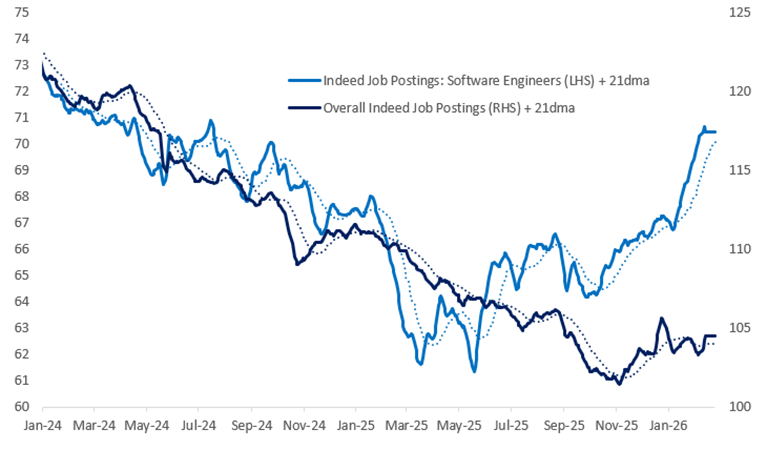
Citadel Securities highlights a recent rise in software engineer job postings. The obvious question is whether other sources show the same thing.
“Job postings for software engineers are rising rapidly, up 11% YoY.” – Citadel Securities
It showed software engineer job postings turning upward at the end of 2025 and continuing to rise into 2026.
I found that striking because the public story around computer science has leaned so heavily in the other direction. For a while now, the dominant narrative has been decline: fewer jobs, shrinking opportunity, and AI sweeping away the bottom rungs of the ladder.
So I think it is worth asking a simple question.
Is that graph picking up something real?
My view is yes.
The stronger case, though, comes from whether independent sources show the same thing.
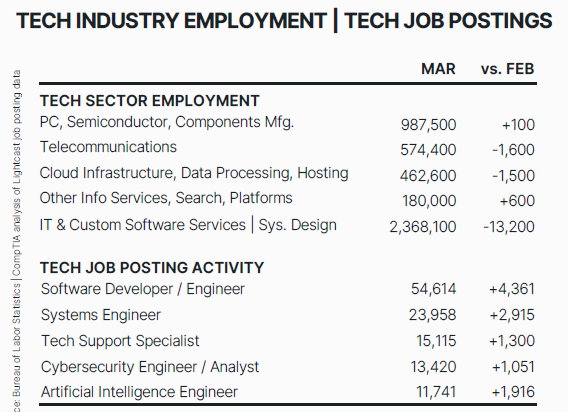
CompTIA, using Lightcast job posting data, shows Software Developer / Engineer postings increasing in March 2026.
CompTIA’s April 2026 report offers independent evidence that software developer and engineer postings rose in March.
In that report, Software Developer / Engineer postings rose to 54,614 in March 2026, up 4,361 from February. Remote Software Developer / Engineer postings also increased, rising by 1,403 month over month.
To me, that is where the argument starts to feel more convincing.
It is a separate data source telling a similar story.
There is more in that same report that I think students should notice.
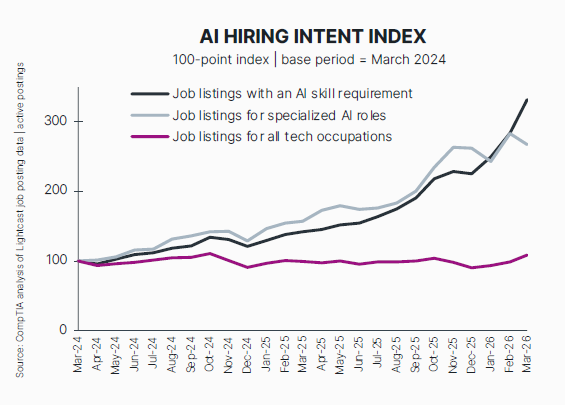
The growth is not only about software jobs in the abstract. It is also about changing skill demand. The report shows sharp growth in AI-related hiring intent and continued demand for technical roles tied to data, cloud systems, cybersecurity, and engineering.
That is a useful correction to the common claim that AI is simply wiping out computer science jobs.
What the evidence suggests, at least to me, is something different.
The jobs are still there. The skill mix inside them is shifting.
“AI skills requirements continued their upward trajectory”
CompTIA chart showing growth in job listings with an AI skill requirement.
Dice points in a similar direction.
In its February 2026 Tech Jobs Report, Dice reported that tech job postings increased 12% month over month in January 2026. The report also noted that AI skill requirements appeared in 58% of U.S. tech job postings, up from 51% the month before, and up 108% from January 2025.
That does not mean every software professional needs to become a machine learning researcher.
But it does mean AI is moving from the margins toward the center of technical work.
If you are studying computer science right now, one thing to keep in mind is that AI is increasingly showing up as part of the expected toolkit. That can mean machine learning. It can mean data science. It can mean working with LLMs and natural language processing. It can also mean understanding how to build systems around AI tools rather than simply calling an API.
I would give natural language processing special attention here, because transformers and large language models sit so close to the center of current AI development.
“The disruption is happening at the level of skills.”
The job titles often stay familiar. Software engineer. Developer. Analyst. Data engineer.
But the expectations inside those roles change.
That shift matters.
Students still need the foundations of computer science. At the same time, they need to be paying attention to where employers are putting new emphasis.
In practical terms, I think that means coursework and projects in AI, machine learning, data science, and natural language processing are becoming more valuable.
“Computer science is still a strong path. But the center of gravity is moving.”
I think that is the main thing students should take from all of this.
The current evidence does not support a simple collapse story. Recent data suggests that software-related postings have turned upward. The Citadel chart raised the question, and CompTIA and Dice provide strong outside support.
At the same time, the market is asking for something a little different than it was asking for several years ago.
Core software skills still matter. They matter a lot. But they increasingly sit alongside AI, data, cloud, and systems thinking.
That is one reason I continue to think computer science remains a strong major. If software is becoming more connected to AI tools, data pipelines, cloud platforms, and language technologies, then students who understand those systems will be in a stronger position.
For students deciding whether to major in computer science, that is a useful distinction.
The story here is not disappearance.
It is change.
And I think students are better served when we talk about that change directly.
Final thought
If you have been hearing that computer science is dead, I would be cautious about accepting that story too quickly.
The market cooled. That part was real.
But recent data suggests that postings have begun to rise again, and the deeper shift seems to be toward new skill combinations rather than simple job disappearance.
So if you are in computer science now, or considering it, my suggestion is to build the fundamentals and then add modern layers on top of them. Study algorithms, data structures, systems, and databases. In addition, spend real time with AI, machine learning, data science, and natural language processing.
That combination looks increasingly relevant to me.
Related Articles
If you are thinking about computer science careers, AI, and what students should be learning right now, these pieces connect closely to this discussion.
Is Computer Science Dead in 2026?
A broader look at the headlines around AI and computer science jobs, and why the simple collapse story does not hold up very well.
Programming After Programmers
A response to the New York Times Magazine article on AI and coding, with a focus on why systems thinking and domain knowledge still matter.
What You Learn in Computer Science
An overview of the core ideas behind software systems, and why those ideas still matter in an AI-heavy environment.
]]>Curry GuinnHas AGI Already Been Achieved? A Response to Nature’s Human-Level Intelligence Argument2026-03-26T00:00:00+00:002026-03-29T00:00:00+00:00https://curryguinncspb.github.io/artificial-intelligence/AGI-has-been-achieved“By reasonable standards… we have artificial systems that are generally intelligent.”
A recent Nature article makes a direct claim: artificial general intelligence may already have been achieved.
I went into the article skeptical. What kept me reading was how the argument comes together and how carefully the authors define what they mean by intelligence.
What counts as artificial general intelligence?
The argument begins with a simple question: what do we actually mean by artificial general intelligence?
Over time, the definition has picked up additional expectations. It now often implies perfection, complete coverage across domains, and consistently superhuman performance. That makes it difficult to compare to anything human.
The authors take a more grounded approach. General intelligence is the ability to handle a wide range of cognitive tasks at roughly a human level. That includes language, reasoning, mathematics, and problem solving. With that definition in place, the discussion becomes much more concrete.
“A definition that excludes essentially all humans is not a definition of general intelligence.”
Human-level intelligence across many domains
“No single test is definitive, but evidence accumulates.”
Models can pass exams, write and debug code, assist with research, generate ideas, and move across domains with a flexibility that we had not seen before. It is easy to push back on individual examples, but when you step back and look across them, the breadth becomes harder to dismiss. That raises a related question about what this means for software development and careers, something I explore in more detail in Programming After Programmers.
Why AGI standards have shifted beyond human intelligence
One idea that stood out to me is how much the definition of AGI has changed over time.
The bar has become flawless reasoning, complete coverage across domains, and even major scientific breakthroughs.
We don’t judge human intelligence by those standards.
Humans make mistakes, rely on imperfect reasoning, get things wrong, have limited areas of expertise, and most never produce major scientific or artistic breakthroughs.
If a definition of AGI excludes humans, then the definition itself has moved away from the concept it was meant to capture.
Common objections to calling today’s AI AGI
“There would be great opposition [to thinking machines] from the intellectuals who were afraid of being put out of a job. It is probable though that the intellectuals would be mistaken about this.”
Alan Turing, Intelligent Machinery, A Heretical Theory, lecture to the 51 Society, University of Manchester, c. 1951.
The objections are familiar and worth taking seriously.
The “stochastic parrot” argument suggests that models are simply remixing training data. That explanation starts to break down when models write working code for new problems, respond to unfamiliar prompts, and apply knowledge in contexts that were not part of their training data.
There is also the question of whether these systems actually understand what they are saying, or whether they are only producing convincing language. In practice, these systems can explain concepts, apply them correctly, and adapt them to new situations. That begins to look very close to what we mean by understanding.
If these systems are already approaching human-level performance across many tasks, then the question shifts from whether they are capable to how they will be used in practice. That includes questions about jobs, hiring, and long-term demand, which I examine more directly in this analysis of computer science careers.
Embodiment is another concern. Intelligence is often tied to physical interaction, but we do not require that in every case. We would still recognize intelligence in someone who cannot act physically yet can reason, communicate, and engage with ideas. A mathematician working entirely in symbols, or someone reasoning through complex problems in conversation alone, would still be considered intelligent. That makes it harder to treat physical embodiment as a requirement for intelligence.
Does AGI require autonomy or agency?
This is probably the strongest remaining objection.
These systems do not set their own goals or act independently. They respond to prompts. That difference is real.
“Autonomy matters… but it is not constitutive of intelligence.”
The authors argue that autonomy is separate from intelligence. This is where I start to hesitate. The ability to form goals and act on them feels like a core part of what we mean by intelligence.
Why the AGI debate matters for computer science education
Even if the label remains debated, the shift in capability is already showing up in practice.
It also affects how we think about education. In programs like the CU Boulder Applied Computer Science Post-Baccalaureate program, there is increasing emphasis on working effectively with AI systems and understanding how they fit into larger workflows.
Has AGI already been achieved?
The authors are making a direct claim that artificial general intelligence has already been achieved. You can disagree with the label, but the argument itself is difficult to dismiss.
These systems are operating across domains with a breadth and flexibility that used to define the problem itself.
At a minimum, this forces a more careful comparison between human and machine intelligence. If we continue to say that AGI has not been achieved, we need to be clear about the standard we are using and whether that standard is one that humans actually meet.
“There would be plenty to do in trying to keep one’s intelligence up to the standard set by the machines, for it seems probable that once the machine thinking method had started, it would not take long to outstrip our feeble powers.”
Alan Turing, Intelligent Machinery, A Heretical Theory, lecture to the 51 Society, University of Manchester, c. 1951. (emphasis mine)
Related Articles
If you are thinking about artificial intelligence, computer science, and what these changes mean for students and professionals, these pieces connect closely to this discussion.
Programming After Programmers
A response to the New York Times on AI and coding, and why system design and domain knowledge may matter even more as code generation becomes easier.
]]>Curry GuinnIs Computer Science Dead in 2026? What the Data Says About AI and Jobs2026-03-23T00:00:00+00:002026-03-26T00:00:00+00:00https://curryguinncspb.github.io/is-cs-really-deadA few months ago, the Northwestern University Center for Inclusive Computing (CIC) hosted a learning session featuring Will Markow, Founder and CEO of FourOne Insights.
The session centered on a question many students are quietly asking: is computer science still a good bet?
If you’ve been following headlines, you’ve probably seen some version of this story:
“Tech jobs have dried up.”
“The computer science bubble is bursting.”
“AI is replacing entry-level developers.”
It’s a compelling narrative, but it leaves out some important context.
“Whenever you hear headlines, take it with a grain of salt.”
That line came early in the talk and framed the rest of the discussion. A common claim right now is that AI is driving the decline in entry-level CS jobs, but when you line up the timing, that explanation doesn’t hold up very well.
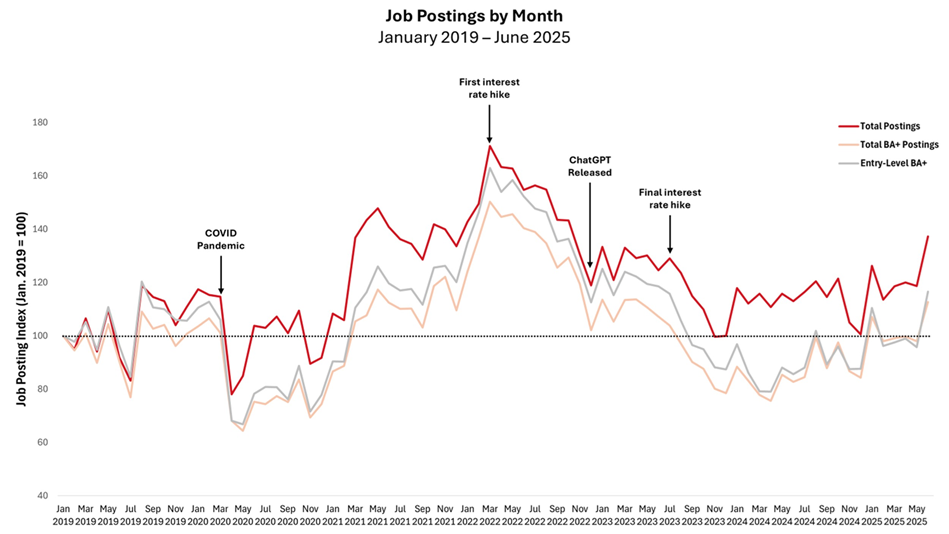
Job postings by month (2019–2025). The largest declines align with interest rate hikes, not the release of ChatGPT. Source: Will Markow, FourOne Insights.
Take a look at the figure above. The steepest drop in job postings happens before ChatGPT is released. What lines up more closely is the first interest rate hike, followed by another drop after the next round of increases.
That doesn’t mean AI has no impact. But the data suggests that broader economic factors, especially interest rates and general uncertainty, are doing more of the work here.
That doesn’t mean AI has no impact. But the data suggests that broader economic factors, especially interest rates and general uncertainty, are doing more of the work here.
At that point, it helps to ask a different question. If this isn’t primarily an AI story, then what changed? Part of the answer involves how AI is reshaping the nature of programming work itself, something I explore in more detail in this discussion of how AI is changing coding and software development.
“What we saw after the pandemic was probably the anomaly.”
This is where expectations matter. If you started your degree during the post-pandemic hiring boom, your sense of the market was shaped by a very unusual period. Demand surged, salaries climbed quickly, and it looked like that pace might continue.
It didn’t.
What we’re seeing now is not a collapse. It’s a return to something closer to the mid-2010s.
In general, today’s market looks much more typical than the one many students saw when they chose computer science. That shift feels sharp, but mostly because the baseline was so high.
“The problem is not just demand. It’s also supply.”
At the same time demand cooled, supply increased. More students entered computer science programs than ever before, which made sense given the signals at the time.
Now those students are graduating into a more typical market. Even if job openings are still healthy by historical standards, there are more people competing for them. That combination is what makes the market feel tight.
“We don’t see evidence that AI is replacing jobs at scale.”
This was one of the more surprising findings. If AI were broadly replacing workers, you would expect companies investing heavily in AI to reduce hiring elsewhere.
But that’s not what the data shows.
Companies that are hiring for AI roles are also hiring more for non-AI roles.
In general, organizations leaning into AI are often the ones growing overall. One thing to keep in mind is that this doesn’t mean AI isn’t changing the field. It is, but the change shows up differently.
“The disruption is happening at the level of skills.”
Jobs are not disappearing. They are evolving. Over the past decade, employers have steadily shifted what they ask for, with growth in areas like AI, machine learning, and cloud, alongside continued demand for Python and cybersecurity. I wrote about this idea in more detail in a recent response to a New York Times Magazine article, where the focus shifts from writing code to understanding systems.
The job titles often stay the same, but the expectations inside those roles change. That means the question is not just whether jobs exist. It’s whether your skills line up with where those jobs are going.
There has been a lot of attention on “prompt engineering” as a new career path. It helps to put that in context.
Over the past year, there have been fewer than 500 job postings for prompt engineers, compared to more than 500,000 postings for software developers. The newer roles get attention, but the core roles still dominate.
A longer view of demand
So far, we’ve focused on recent changes. It helps to zoom out.
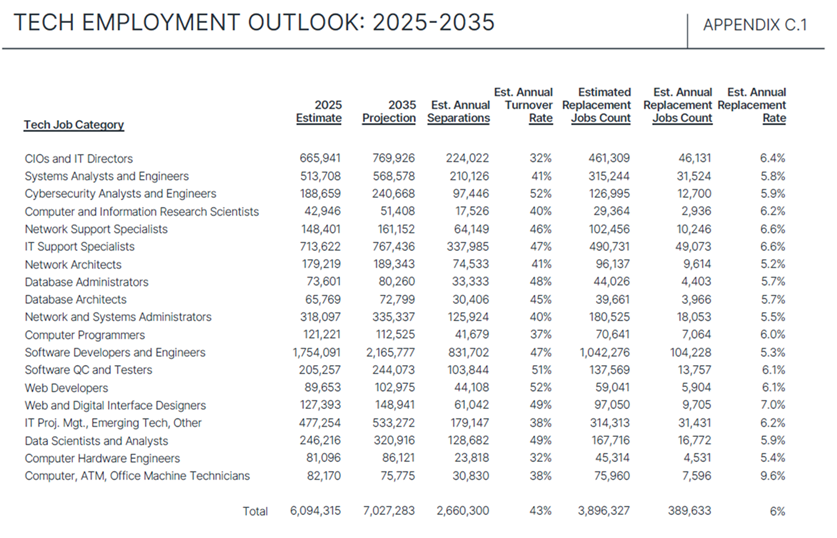
Tech employment outlook (2025–2035). Most hiring demand comes from turnover and replacement, not just new job creation. Source: CompTIA.
Total tech employment is projected to grow from about 6.1 million to 7.0 million jobs over the next decade. That’s steady growth.
The more important number is this:
2.6 million annual separations
People switch jobs, get promoted, and retire. Those movements create openings, which is what keeps demand for technical roles high even when net growth looks modest.
So what should you take from this?
I think the main thing is this. Computer science is not “dead,” but the simple story about it doesn’t hold up very well.
The path is still strong. The salaries are still high. The work is still in demand. But it’s no longer enough to assume that a degree alone will carry you.
You need to build real projects, develop skills that reflect current demand, and be able to explain how you think, not just what you built.
Even leaders at major AI companies emphasize that the value of computer science training is not just coding. It’s systems thinking, design, and the ability to reason about complex problems.
This is also the perspective we take in the CSPB program, where the focus is not just on coding, but on building systems and developing strong technical foundations.
Final thought
If you’re considering computer science, or already in the field, it’s worth stepping back from the headlines. The market has cooled from an unusually hot period, but the underlying fundamentals have not changed as much as the narrative suggests.
If anything, the field is becoming more interesting. You’re not just learning to write code. You’re learning how to build systems, work with evolving tools, and make decisions in environments where the answers are not always obvious.
That’s a valuable skill set in any market.
If you want to explore Will Markow’s work further, I’d recommend this conversation:
If you are trying to understand how AI is affecting computer science careers and what to do next, these pieces explore closely related questions.
Programming After Programmers
A deeper look at how AI is changing the role of developers and shifting the emphasis toward system design and problem framing.
Has AGI Already Been Achieved?
A broader discussion of AI capability and what it means to describe systems as having human-level intelligence.
Career Change into Computer Science
Practical considerations for transitioning into software development and building a strong technical foundation.
]]>Curry GuinnProgramming After Programmers? A Response to the New York Times on AI and Coding2026-03-15T00:00:00+00:002026-03-29T00:00:00+00:00https://curryguinncspb.github.io/programming-after-programmers
The New York Times Magazine recently published a provocative essay titled:
“Coding After Coders: The End of Computer Programming as We Know It.”
The article explores a question that is increasingly on the minds of students, engineers, and executives alike. If AI systems can write software, what happens to programmers? This is a question I explore from a data perspective in this analysis of the current computer science job market.
It is a fair question. But when you read the article carefully, a different story begins to emerge.
“The realms of programmers and everyday people… are drifting closer together.”
One of the most interesting passages in the New York Times article describes how conversational AI tools are reshaping who writes code.
“The realms of programmers and everyday people, separated for decades by an ocean of arcane know-how, are drifting closer together.”
That observation is hard to dispute. Tools like ChatGPT, Claude, and Copilot now make it possible for non-programmers to generate working code for the first time.
But there is an important detail in that shift. The number of people creating software will likely increase dramatically. Turning that code into reliable software systems is a different challenge altogether.
Those are different roles, and they require different skills.
Writing code is one thing. Designing a system that works at scale, survives failure, and evolves over time is another.
“Maybe they don’t label themselves as software engineers, but they’re creating code.”
The NYT article quotes economist Erik Brynjolfsson describing this dynamic:
“Maybe they don’t label themselves as software engineers, but they’re creating code.”
In other words, coding itself is becoming far more widespread. That does not mean professional developers disappear. It means that code generation is becoming easier.
The real question is what happens after that shift: who designs the systems, who evaluates the outputs, and who understands the domain where the software is deployed?
Those tasks depend on a deeper layer of knowledge. Large software systems rely on ideas that cannot simply be improvised by a prompt: algorithms, data structures, databases, distributed systems, and the architectural decisions that connect them.
Even when AI helps generate code, someone still has to decide how the system should work.
That is where computer science comes in.
Why Computer Science Matters More
Ironically, the rise of AI may make computer science education more important, not less.
When code becomes easier to generate, the limiting factor shifts from typing syntax to understanding systems. Someone still has to decide how software should behave, how data should be structured, and how a system should perform under load or failure.
A computer science curriculum focuses on exactly those foundations:
Algorithms and data structures, which determine whether software runs in milliseconds or minutes
Computer systems, which explain how memory, processes, and networks actually behave
Databases, which determine how information can be stored and retrieved reliably
Object-oriented design, which allows complex systems to remain maintainable
Software engineering methodologies, which allow teams to build and evolve systems over time
These ideas rarely appear in AI-generated snippets of code. But they determine whether the resulting software actually works.
“Employers aren’t just looking for programmers anymore. They need computer scientists who can bridge the gap between technical capability and real-world application; who understand both the code and the context in which it operates.”
AI may help write programs.
Computer science teaches you how to understand them.
The Interdisciplinary Programmer
But technical depth alone is not the whole story.
The most valuable developers increasingly combine computer science with expertise in another domain. Software only matters when it interacts with the real world, and that means understanding the systems where the software is deployed.
Education researcher Aviva Legatt makes this point clearly in the same Forbes article:
“Those who combine computer science with domain expertise in healthcare, finance, or other fields are finding significantly better opportunities.”
She goes on to recommend a specific educational path:
“I would recommend a double major in computer science and another subject such as systems engineering, business, or healthcare.”
The logic is straightforward. Healthcare systems require engineers who understand clinical workflows. Financial systems require engineers who understand markets. Educational technologies require engineers who understand how people learn.
The most effective developers increasingly combine technical foundations with domain expertise.
The Real Question
So perhaps the real question is not whether AI will eliminate programmers.
The more interesting question is what kind of programmer the AI era will reward.
If the evidence from both industry and education is any guide, the answer is becoming clearer.
The most valuable programmers may be the ones who were never just programmers to begin with. They are biologists building simulation engines, philosophers working on AI governance, economists designing financial systems, and teachers building educational technology.
They understand both the technical foundations of computing and the domains where software actually matters.
In other words, they bring two ways of thinking to the same problem.
Final Thought
The New York Times article is correct that programming is changing.
But the deeper transformation is not about replacing programmers.
It is about expanding what it means to be a programmer.
Related Articles
If you are thinking about how AI is changing software development and computer science, these pieces explore closely related ideas.
Has AGI Already Been Achieved?
A closer look at whether modern AI systems already meet a reasonable definition of human-level intelligence.
]]>Curry GuinnTeaching Computer Science and the CSPB Program: A Q&A2026-03-13T00:00:00+00:002026-03-29T00:00:00+00:00https://curryguinncspb.github.io/computer%20science%20education/cspb/qa-about-teaching-and-the-cspb-program
Curry Guinn on the University of Colorado Boulder campus.
Earlier this year the CU Boulder Online team published a short Q&A with me about teaching computer science and the Applied Computer Science Post-Baccalaureate program. The interview discusses my background, what makes the program distinctive, and some practical advice for students who are learning computer science or considering a career transition into the field.
You can read the original interview here:
Originally published on the CU Boulder Online website.
Below is a lightly edited version of the interview content with a few highlights.
Background
I currently teach in the Applied Computer Science Post-Baccalaureate program at the University of Colorado Boulder, with courses including natural language processing, data structures, and professional development in computer science. Before joining CU Boulder in 2024, I spent ten years in industry as a research engineer at RTI International and then twenty years as a professor at the University of North Carolina Wilmington.
My academic background combines computer science and philosophy, which led naturally to interests in artificial intelligence and questions about how computers represent knowledge and reasoning.
Why computer science?
One of the reasons I have always enjoyed computer science is the balance between creativity and discipline. You begin with an idea, try to turn it into a working system, and then refine it through testing and iteration until the result is reliable and understandable.
Another appealing aspect of the field is its breadth. Once you learn the core principles of computing, you start to see opportunities to apply them in almost every domain, from science and medicine to business and education. Those are some of the same foundations I describe in more detail in this overview of what students learn in the program. Students in the post-baccalaureate program often bring expertise from earlier careers and find interesting ways to combine that experience with computing.
Why teach in the Applied Computer Science program?
What drew me to CU Boulder’s Applied Computer Science Post-Baccalaureate program was the focus on students who are making a deliberate transition into computer science. Most students already hold a bachelor’s degree and are choosing to build technical skills with clear goals in mind. In many ways, they are the kinds of students described in this guide to who the program is designed for.
The students are one of the most rewarding aspects of the program. Many are balancing work, family, and coursework while building new technical abilities. That level of motivation makes the teaching experience particularly meaningful.
The program also demonstrates that online learning can be excellent when it is carefully designed. Clear weekly structure, active discussion forums, and regular interaction between students and instructors can create a surprisingly strong learning community.
What distinguishes the program?
From my perspective, the program stands out in three important ways.
First, courses are structured and interactive rather than hands-off. Students participate in discussion forums, attend office hours, and work through assignments on a steady weekly rhythm.
Second, the work emphasizes building real systems rather than memorizing concepts. Students write code, test their solutions, and document their decisions.
Third, the curriculum supports multiple goals while keeping students grounded in fundamentals. Some students are preparing for software engineering roles, some are aiming for graduate school, and others are combining computing skills with their existing careers.
Advice for students entering computer science
One of the most important observations I have after teaching in the program is that success often comes from consistency rather than prior background.
Students who thrive usually do a few simple things well:
Show up every week and build momentum.
Engage with discussion forums and learn from other students.
Use office hours to get unstuck quickly.
Treat challenging problems as part of the learning process.
Build artifacts—projects, repositories, and writeups—that demonstrate what they can do.
Over time those habits build both technical ability and confidence.
Looking ahead: AI and the future of software development
Artificial intelligence is already reshaping how software is built. Tools can generate code and accelerate prototyping, but that does not reduce the importance of strong computer science foundations.
If anything, it raises the bar. Engineers will need to evaluate AI-generated code, test it carefully, understand its limitations, and design systems that behave reliably in real environments.
The engineers who stand out will still be the ones who can think clearly about problems, test their solutions, and explain their work.
For prospective students
If you are considering a transition into computer science or looking for an online program designed for students who already hold a bachelor’s degree, the Applied Computer Science Post-Baccalaureate program at the University of Colorado Boulder may be worth exploring.
I have a separate page on this site that describes the program from a faculty perspective, including the kinds of courses students take, the pathways they often follow, and the types of projects they build.
If you are exploring computer science as a field of study or career transition, these pages offer additional perspective on program fit, curriculum, and how the field is changing.
Is This Program Right for You?
A closer look at the kinds of students who often benefit from a structured path into computer science.
What You Learn
An overview of the core computer science ideas and practical skills students build in the program.
Programming After Programmers
A broader discussion of how AI is changing software development and why strong computer science foundations still matter.
]]>Curry GuinnAI for Poets: Why Interdisciplinary Thinkers Matter in the Age of AI2026-03-01T00:00:00+00:002026-03-29T00:00:00+00:00https://curryguinncspb.github.io/ai-for-poets-reflectionRecently we hosted Ben Snyder, Senior Applied Scientist at Amazon Web Services, for a talk in the CSPB Speaker Series titled AI for Poets (or Poets for AI).
Ben Snyder, Senior Applied Scientist at Amazon Web Services.
Ben’s main point was simple. As AI tools automate more routine coding work, the skills that matter begin to shift. Writing code still matters, but understanding the problem and designing the solution matter even more.
One thing that struck me during the talk is how closely this idea aligns with the structure of the CSPB program.
Every student in this program already has a degree in another field before studying computer science. That might be physics, economics, psychology, biology, journalism, music, or something else entirely. Those backgrounds are not a detour. In many cases they become the domain knowledge that makes your technical work valuable, especially in a field where AI is changing what kinds of software skills matter most.
Ben’s own path reflects that kind of trajectory. He began in sociology, later moved into statistics, and eventually completed a degree in computer engineering. Each step added another way of looking at problems.
That kind of interdisciplinary thinking is becoming more common in AI.
Modern systems often sit at the intersection of several domains. You might be building software that interacts with logistics systems, robotics, agriculture, finance, medicine, or manufacturing. Understanding the software is important. Understanding the domain is just as important.
But another point Ben made during the talk is easy to miss in all the excitement around AI tools: the technical foundations still matter.
Toward the end of the talk he was asked how he would teach introductory computer science today. His answer was telling.
“First of all, I would probably still have an incredibly annoying entry course on something like C++… basically when I learned coding they were like, go learn C++.”
His point was not nostalgia for old programming languages. It was that students still need a place where they learn how software actually works: how programs execute, how systems behave, and how to reason about code.
At the same time, he emphasized that modern developers also need to understand how to work effectively with new AI systems.
“I think we need to have courses in actually teaching people how to not only code, but how to interact with the new AI coding tools, and how to understand the relation between the two.”
A related theme that came up in discussion is how the day-to-day work of programming is already shifting. Less time is spent writing every line of code from scratch, and more time is spent evaluating outputs, refining prompts, and making design decisions. In that environment, the role of the developer becomes less about typing and more about judgment.
That shift also highlights an important limitation of current AI systems. Unlike compilers, which are deterministic and verifiable, AI-generated outputs require interpretation and validation. Even when the output looks correct, it still needs to be checked against the intended behavior of the system.
One of Ben’s most interesting comments came when he discussed how real AI systems are actually built in practice.
“Realistically, we need to know how to make traditional statistical models, machine learning, and large-scale AI work together.”
That line captures something important about modern software development. The tools may be evolving quickly, but the systems we build still rely on multiple layers of knowledge.
Understanding AI today often means understanding how several ideas fit together: statistics, machine learning, large-scale systems, and the software that connects them.
The conversation also touched on career preparation. One consistent takeaway is the importance of being able to explain a project from beginning to end. Not just what the code does, but how the idea developed, what tradeoffs were considered, and how decisions were made along the way.
Projects make that visible. They show how someone thinks. They also give candidates something concrete to talk about during interviews. This is becoming increasingly important as employers look for signals beyond resumes alone.
In other words, the “poets” in Ben’s title are not just a metaphor. Many students already bring that broader perspective to the field. And in an age where AI can generate code, that combination of technical foundations and broader perspective is becoming even more valuable.
We have posted the full (lightly edited) transcript of the talk here:
If you watched the talk or read the transcript, I’d be curious what stood out to you.
Related Articles
If you are thinking about how AI is changing software work and why interdisciplinary backgrounds matter, these pieces explore closely related ideas.
Programming After Programmers
A response to the New York Times on AI and coding, and why system design and domain knowledge may matter even more as code generation becomes easier.
What You Learn
An overview of the core computer science ideas that still matter even as AI tools make coding faster and more accessible.
Is This Program Right for You?
A closer look at the kinds of students who often benefit from a structured path into computer science.