Is Computer Science Dead in 2026? What the Data Says About AI and Jobs
A few months ago, the Northwestern University Center for Inclusive Computing (CIC) hosted a learning session featuring Will Markow, Founder and CEO of FourOne Insights.
The session centered on a question many students are quietly asking: is computer science still a good bet?
If you’ve been following headlines, you’ve probably seen some version of this story:
“Tech jobs have dried up.”
“The computer science bubble is bursting.”
“AI is replacing entry-level developers.”
It’s a compelling narrative, but it leaves out some important context.
“Whenever you hear headlines, take it with a grain of salt.”
That line came early in the talk and framed the rest of the discussion. A common claim right now is that AI is driving the decline in entry-level CS jobs, but when you line up the timing, that explanation doesn’t hold up very well.
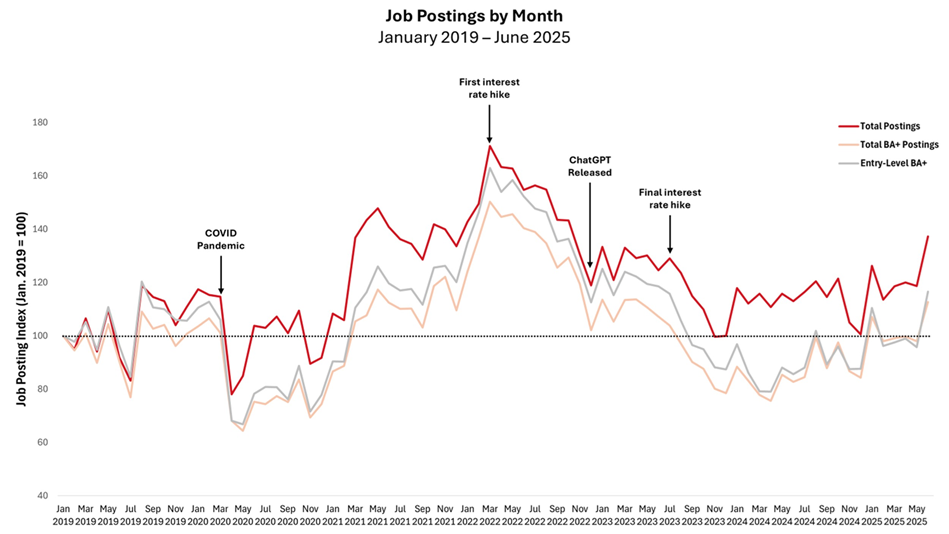
Take a look at the figure above. The steepest drop in job postings happens before ChatGPT is released. What lines up more closely is the first interest rate hike, followed by another drop after the next round of increases.
That doesn’t mean AI has no impact. But the data suggests that broader economic factors, especially interest rates and general uncertainty, are doing more of the work here.
At that point, it helps to ask a different question. If this isn’t primarily an AI story, then what changed?
“What we saw after the pandemic was probably the anomaly.”
This is where expectations matter. If you started your degree during the post-pandemic hiring boom, your sense of the market was shaped by a very unusual period. Demand surged, salaries climbed quickly, and it looked like that pace might continue.
It didn’t.
What we’re seeing now is not a collapse. It’s a return to something closer to the mid-2010s.
In general, today’s market looks much more typical than the one many students saw when they chose computer science. That shift feels sharp, but mostly because the baseline was so high.
“The problem is not just demand. It’s also supply.”
At the same time demand cooled, supply increased. More students entered computer science programs than ever before, which made sense given the signals at the time.
Now those students are graduating into a more typical market. Even if job openings are still healthy by historical standards, there are more people competing for them. That combination is what makes the market feel tight.
“We don’t see evidence that AI is replacing jobs at scale.”
This was one of the more surprising findings. If AI were broadly replacing workers, you would expect companies investing heavily in AI to reduce hiring elsewhere.
But that’s not what the data shows.
Companies that are hiring for AI roles are also hiring more for non-AI roles.
In general, organizations leaning into AI are often the ones growing overall. One thing to keep in mind is that this doesn’t mean AI isn’t changing the field. It is, but the change shows up differently.
“The disruption is happening at the level of skills.”
Jobs are not disappearing. They are evolving. Over the past decade, employers have steadily shifted what they ask for, with growth in areas like AI, machine learning, and cloud, alongside continued demand for Python and cybersecurity. I wrote about this idea in more detail in a recent response to a New York Times Magazine article, where the focus shifts from writing code to understanding systems.
The job titles often stay the same, but the expectations inside those roles change. That means the question is not just whether jobs exist. It’s whether your skills line up with where those jobs are going.
This connects closely to ideas from a previous CSPB Speaker Series talk on how AI is shifting the role of software engineers.
A quick reality check
There has been a lot of attention on “prompt engineering” as a new career path. It helps to put that in context.
Over the past year, there have been fewer than 500 job postings for prompt engineers, compared to more than 500,000 postings for software developers. The newer roles get attention, but the core roles still dominate.
A longer view of demand
So far, we’ve focused on recent changes. It helps to zoom out.
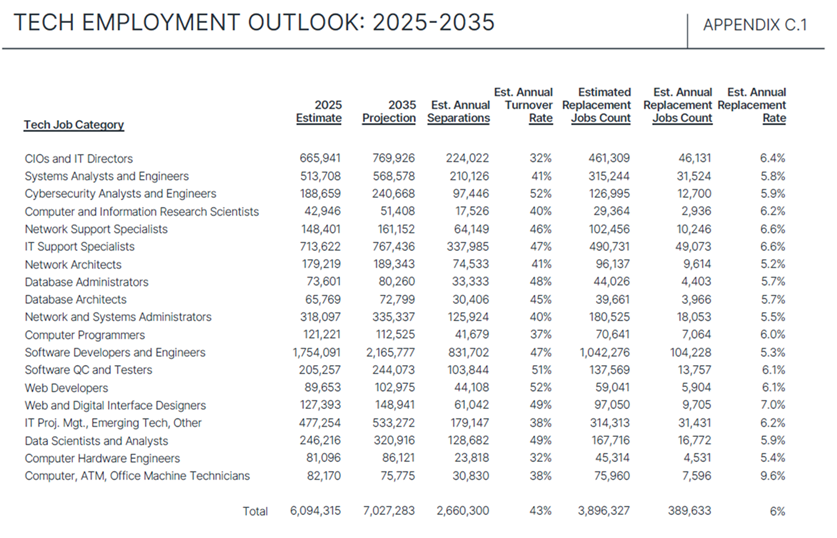
Total tech employment is projected to grow from about 6.1 million to 7.0 million jobs over the next decade. That’s steady growth.
The more important number is this:
2.6 million annual separations
People switch jobs, get promoted, and retire. Those movements create openings, which is what keeps demand for technical roles high even when net growth looks modest.
So what should you take from this?
I think the main thing is this. Computer science is not “dead,” but the simple story about it doesn’t hold up very well.
The path is still strong. The salaries are still high. The work is still in demand. But it’s no longer enough to assume that a degree alone will carry you.
You need to build real projects, develop skills that reflect current demand, and be able to explain how you think, not just what you built.
Even leaders at major AI companies emphasize that the value of computer science training is not just coding. It’s systems thinking, design, and the ability to reason about complex problems.
This is also the perspective we take in the CSPB program, where the focus is not just on coding, but on building systems and developing strong technical foundations.
Final thought
If you’re considering computer science, or already in the field, it’s worth stepping back from the headlines. The market has cooled from an unusually hot period, but the underlying fundamentals have not changed as much as the narrative suggests.
If anything, the field is becoming more interesting. You’re not just learning to write code. You’re learning how to build systems, work with evolving tools, and make decisions in environments where the answers are not always obvious.
That’s a valuable skill set in any market.
If you want to explore Will Markow’s work further, I’d recommend this conversation: