CU Boulder CSPB Alumni Outcomes: Where Applied Computer Science Graduates Work
One of the questions I hear most often from prospective students is also one of the most reasonable.
Where do graduates of the CU Boulder Applied Computer Science Post-Baccalaureate (CSPB) program actually end up?
That question feels especially important right now. AI is changing software work, the tech job market has cooled, and entry-level hiring has felt harder than it did during the peak hiring years.
So I wanted to look at something concrete.
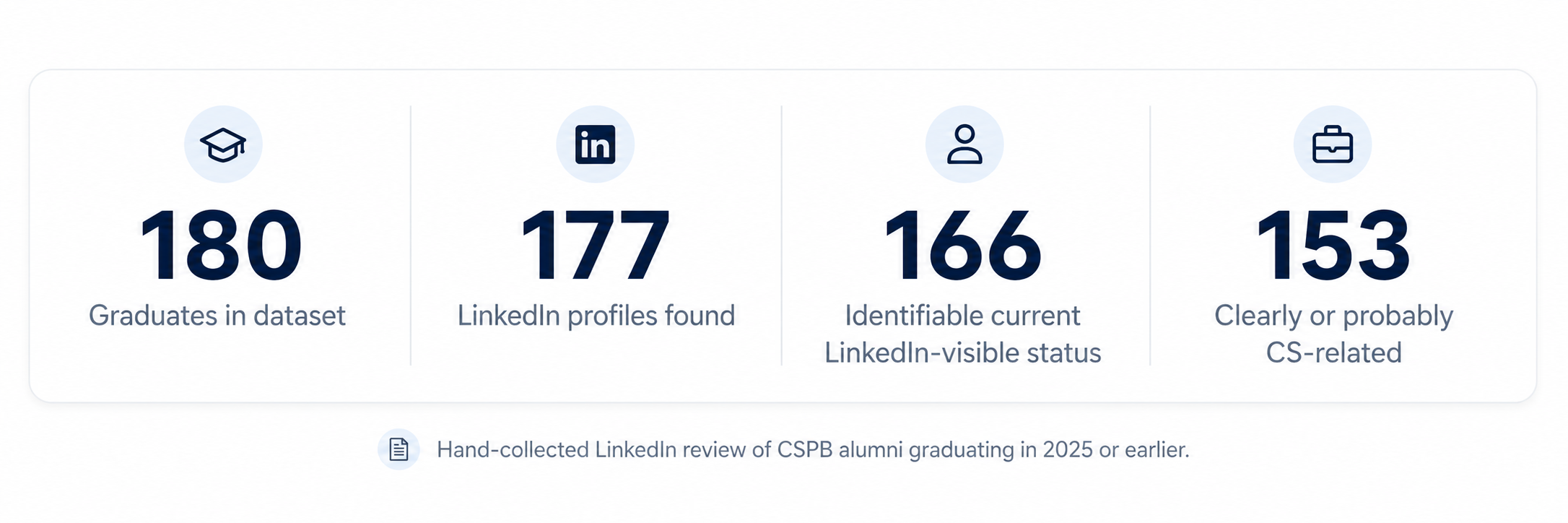
I reviewed LinkedIn-visible outcomes for CSPB alumni who graduated in May 2025 or earlier. For readers new to the acronym, CSPB is CU Boulder’s online post-baccalaureate B.S. in Applied Computer Science.
This is not an official placement report. It is not a university employment survey. It is a hand-collected LinkedIn snapshot.
But I do think it is useful.
I also wrote a companion post focused specifically on career changers: where CSPB alumni came from before the program, how many appear to have moved into CS from another field, and what their first technical roles looked like after starting CSPB: CSPB Career Changers.
“More than 9 in 10 LinkedIn-visible CSPB alumni are in CS-related or CS-adjacent roles.”
The strongest finding is also the simplest.
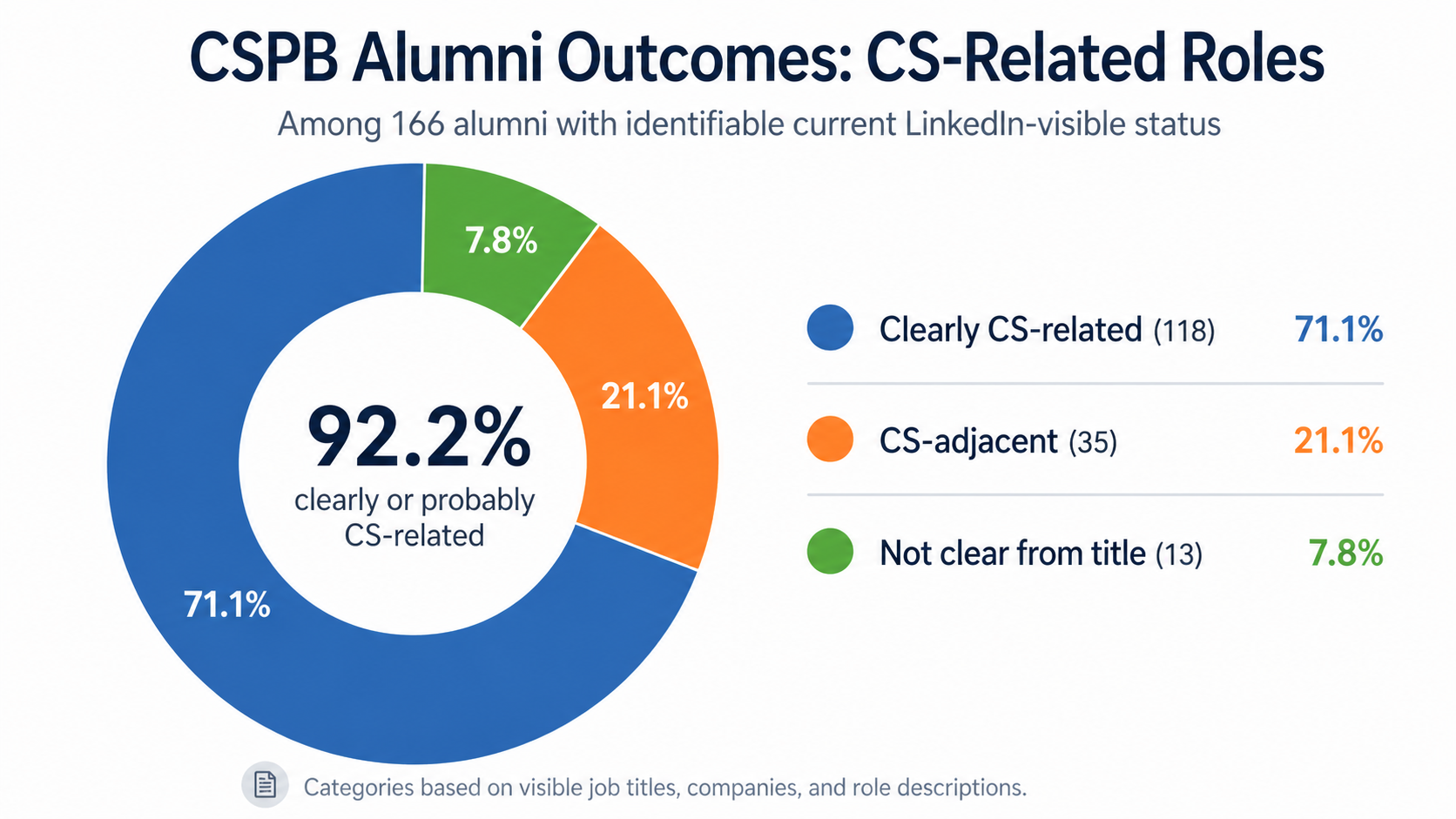
Among the 166 alumni whose current LinkedIn-visible status could be identified, 153 were in clearly or probably CS-related roles.
That is 92.2%.
I would not overstate this. LinkedIn data is imperfect, and job titles do not always tell the full story of what someone does. But even with those caveats, the pattern is clear.
Most identifiable CSPB alumni outcomes in this dataset are connected to computing.
That includes software engineering, data and analytics, AI and machine learning, cybersecurity, cloud and systems work, technical operations, research computing, bioinformatics, QA and testing, technical leadership, consulting, founder roles, and student pathways.
Computer science outcomes are broader than one job title.
“Software engineering is the largest CSPB alumni career pathway. It is not the only one.”
Software engineering is the largest single pathway in the dataset.
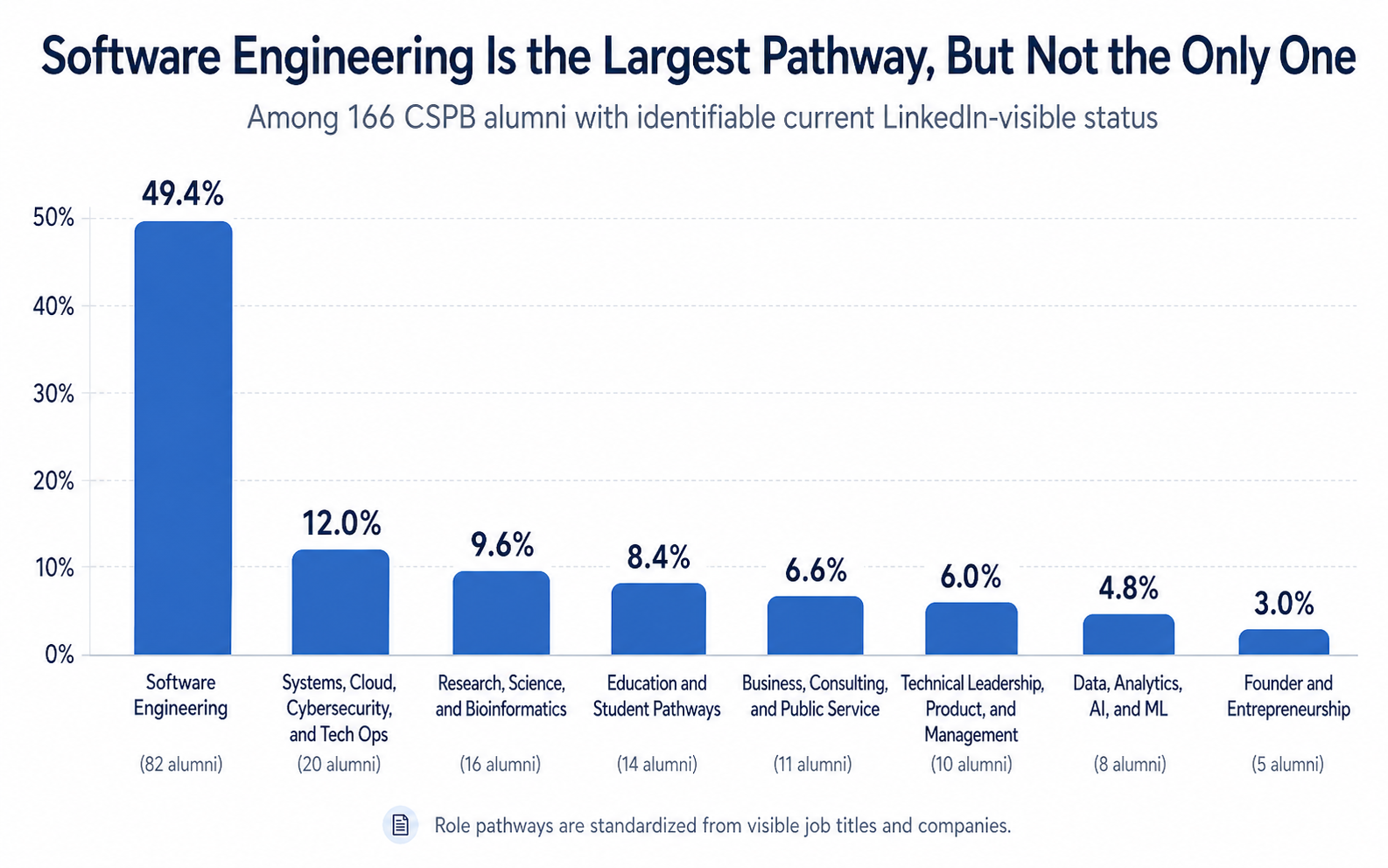
Of the 166 alumni with identifiable current LinkedIn-visible status, 82 are in software engineering roles or roles close enough to software engineering to place them in that pathway.
That is 49.4%.
But the more interesting part is the other half of the chart.
CSPB alumni also appear in systems, cloud, cybersecurity, technical operations, research, bioinformatics, education, student pathways, business, consulting, public service, technical leadership, data, AI, machine learning, and entrepreneurship.
That spread matters because CSPB is a post-baccalaureate program. Many students already have a first degree. Some are changing careers entirely. Others are adding computing to work they already know.
Software engineering is the largest destination, but the broader story is that alumni are using computer science in many different ways.
“Computing careers are not confined to the tech industry.”
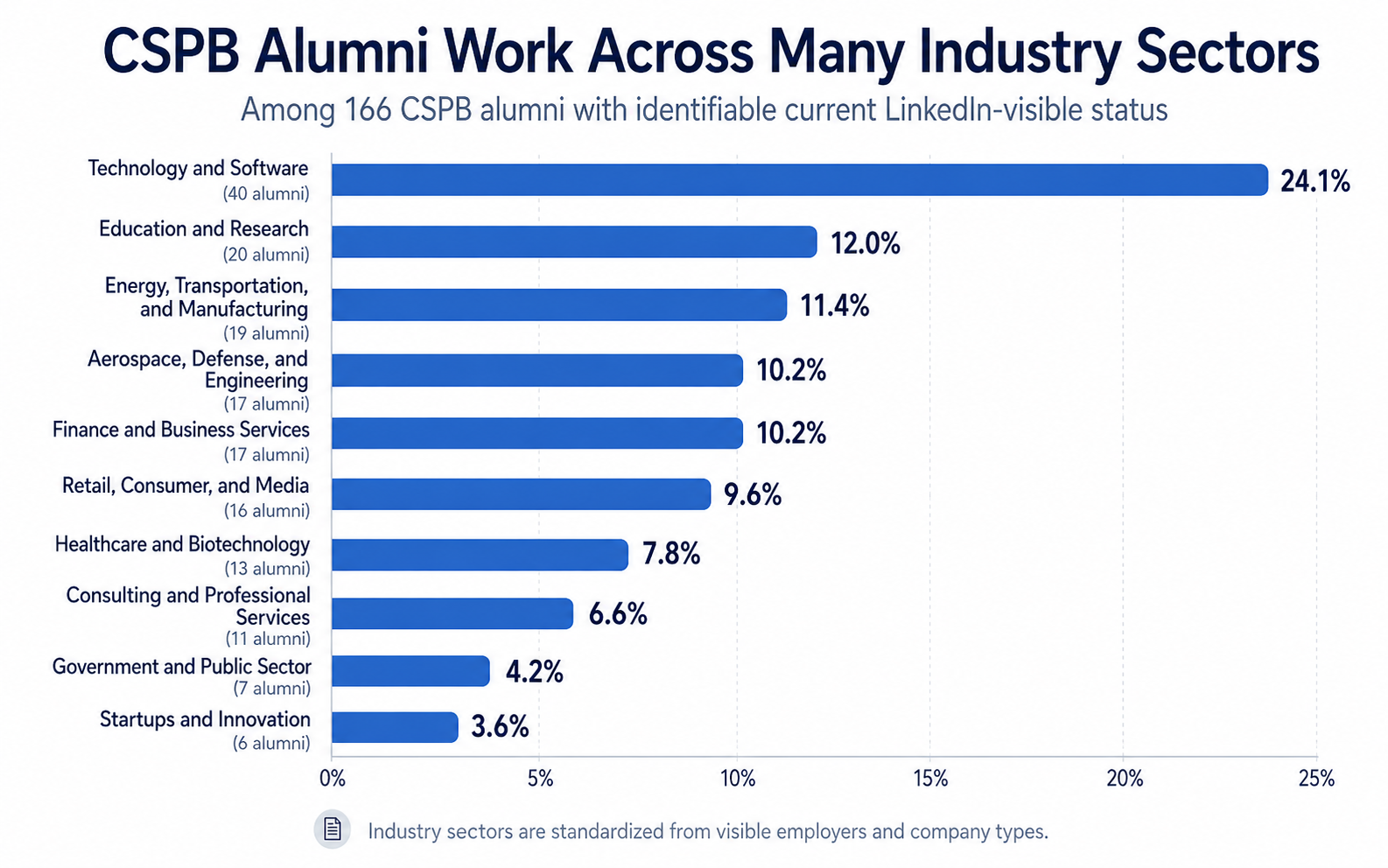
The largest industry sector in the dataset is technology and software.
But it is not the majority.
Technology and software accounts for 40 of the 166 identifiable outcomes, or 24.1%. That means roughly three-quarters of the identifiable alumni outcomes are outside the traditional technology and software sector.
To me, that is one of the most important things in the data.
CSPB alumni appear in education and research, energy, transportation, manufacturing, aerospace, defense, finance, business services, retail, media, healthcare, biotechnology, consulting, government, public sector work, startups, and innovation environments.
That is a useful correction to the way people sometimes talk about computer science. When the tech industry has a difficult year, it is easy to assume that computer science itself has weakened as a path. But computing skills are not confined to technology companies.
Software, data, systems, and computational thinking continue to show up across the economy.
“CSPB alumni employers make the outcomes concrete.”
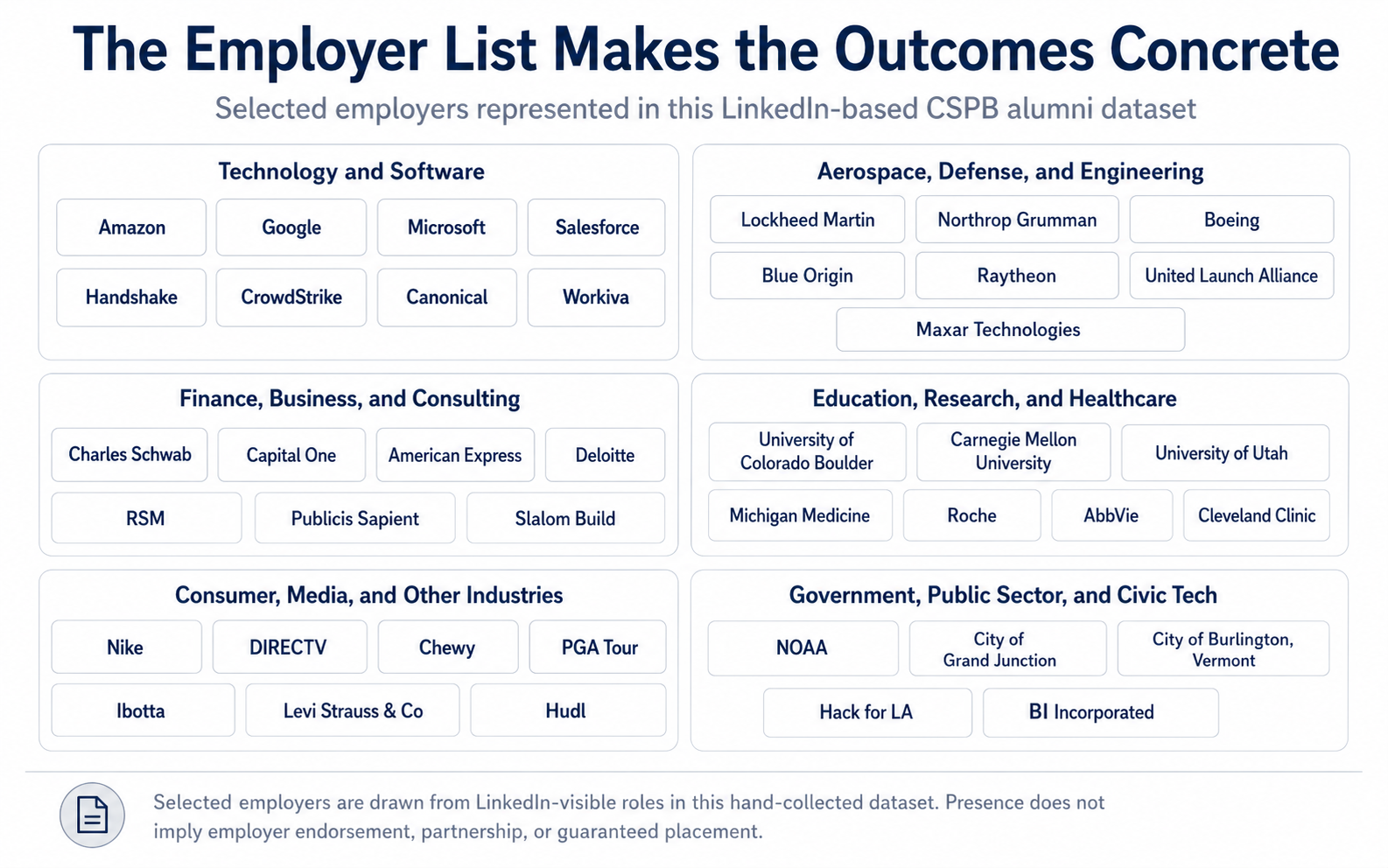
Percentages are useful, but employer names make the picture more concrete.
The employer list in this dataset includes large technology companies, aerospace and defense organizations, universities, research institutions, healthcare organizations, finance firms, consulting firms, public-sector employers, consumer companies, media organizations, and startups.
I want to be careful about how to present that.
This is not a list of official hiring partners. It does not imply endorsement, guaranteed placement, or direct recruiting from the program.
It simply means that alumni in this LinkedIn-based dataset list roles at these organizations.
That is still useful. For prospective students, employer names help translate abstract categories into something more understandable.
The point is not prestige for its own sake.
The point is range.
“CSPB has a strong Colorado footprint, but the outcomes are not only local.”
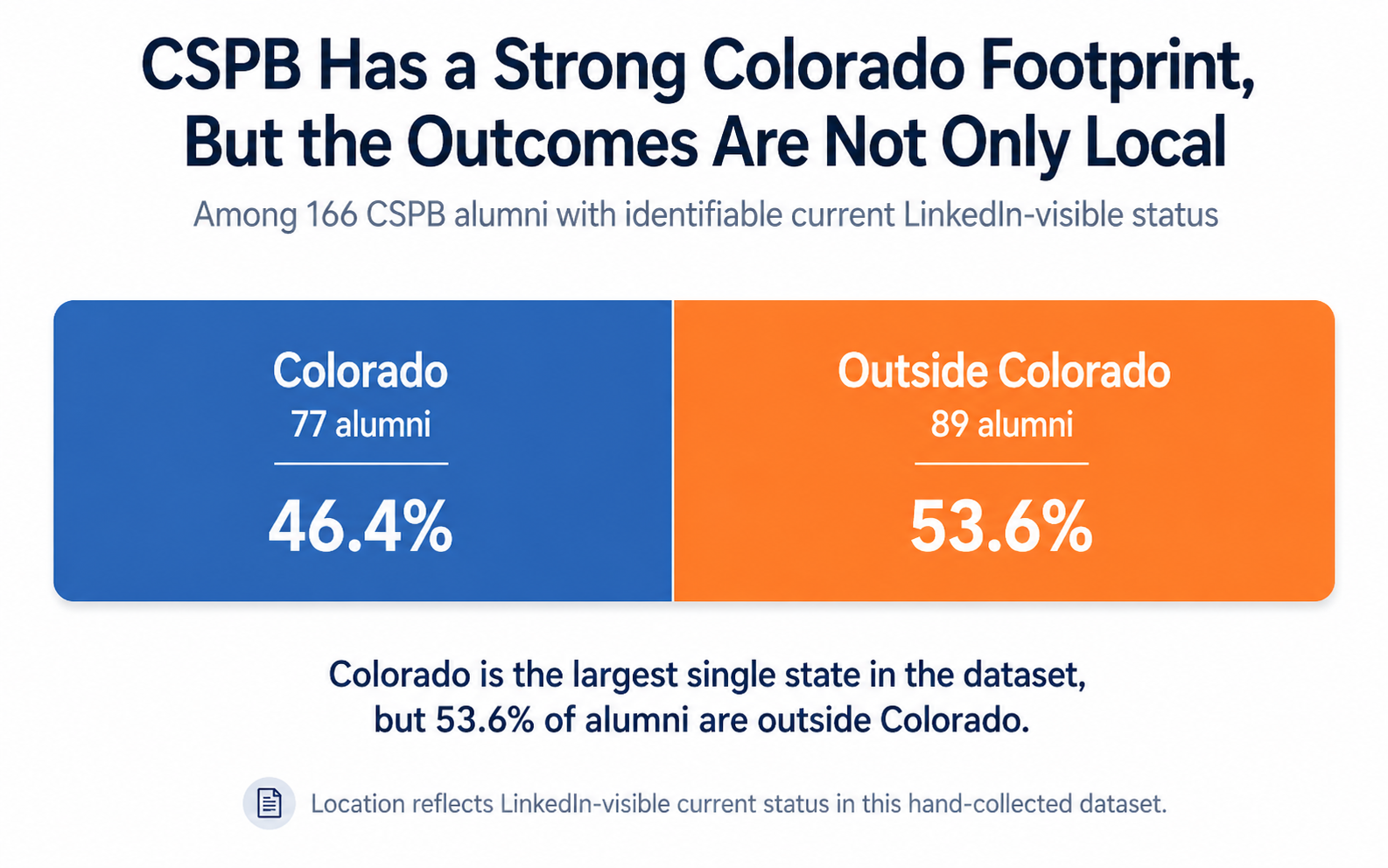
The program has a strong Colorado footprint.
That makes sense. CSPB is a CU Boulder program, and many students and alumni remain connected to the region.
But the outcomes are not only local.
Of the 166 alumni with identifiable current LinkedIn-visible status, 77 are in Colorado and 89 are outside Colorado. That means 46.4% are in Colorado and 53.6% are outside Colorado.
That seems important for an online post-baccalaureate program. CSPB has a strong Colorado identity, but it also serves students who are building careers in many different places.
“This is a LinkedIn-based snapshot, not an official placement report.”
I want to be clear about 2020 limits of this analysis.
This is not official university placement data. It is a hand-collected LinkedIn review of CSPB alumni who graduated in May 2025 or earlier.
That means it depends on whether alumni had LinkedIn profiles, whether those profiles were findable, and whether the profiles appeared current enough to classify.
There was also judgment involved. Job titles had to be standardized. Company names had to be cleaned. Industry sectors had to be assigned. Some roles were clearly CS-related. Others were more adjacent.
So I would not use this dataset to make overly precise claims.
But I do think it is strong enough to show a pattern.
Final thought
The current conversation around computer science can be discouraging.
Students hear that the market is difficult, that AI is changing software work, and that entry-level roles are more competitive than they used to be.
Some of that concern is justified.
But the alumni data here points to a more balanced story.
CSPB graduates are showing up in CS-related and CS-adjacent roles across a wide range of industries and employers.
That does not mean the path is automatic. Students still need to build strong projects, learn the fundamentals, practice technical communication, prepare for interviews, and keep adapting as the field changes.
But the data does suggest that the degree is connecting to real technical outcomes.
The story here is not that every graduate follows the same route.
The story is that computer science opens several routes.
Software engineering is the largest one.
It is not the only one.
Related Articles
If you are thinking about computer science careers, AI, and whether CS remains a strong path, these pieces connect closely to this discussion.
-
CU Boulder CSPB Alumni Career Changes
A broader LinkedIn-based look at prior degrees, previous fields, first technical roles, and career movement among CU Boulder Applied Computer Science post-bacc alumni. -
Computer Science Jobs in 2026: Are Software Engineer Job Postings Rising Again?
A data-driven look at whether software engineering job postings are beginning to rise again, with evidence from Citadel Securities, CompTIA, and Dice. -
Is Computer Science Dead in 2026?
A broader look at the headlines around AI and computer science jobs, and why the simple collapse story does not hold up very well. -
Programming After Programmers
A response to the New York Times Magazine article on AI and coding, with a focus on why systems thinking and domain knowledge still matter. -
Career Change into Computer Science
A practical look at what it takes to move into software and build a strong foundation in the field. -
What You Learn in Computer Science
An overview of the core ideas behind software systems, and why those ideas still matter in an AI-heavy environment.