Computer Science Jobs in 2026: Are Software Engineer Job Postings Rising Again?
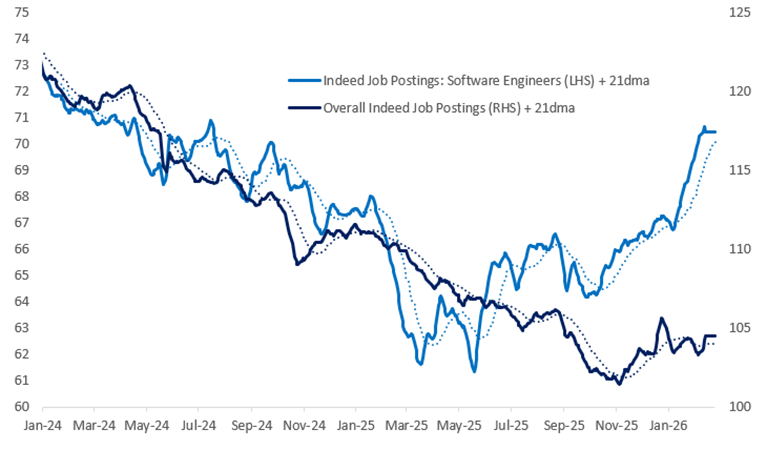
A chart and a quote from Citadel Securities recently caught my eye.
“Job postings for software engineers are rising rapidly, up 11% YoY.” – Citadel Securities
It showed software engineer job postings turning upward at the end of 2025 and continuing to rise into 2026.
I found that striking because the public story around computer science has leaned so heavily in the other direction. For a while now, the dominant narrative has been decline: fewer jobs, shrinking opportunity, and AI sweeping away the bottom rungs of the ladder.
So I think it is worth asking a simple question.
Is that graph picking up something real?
My view is yes.
The stronger case, though, comes from whether independent sources show the same thing.
“Software Developer / Engineer 54,614 +4,361”
A stronger confirmation comes from CompTIA’s April 2026 Tech Jobs Report, which draws on Lightcast posting data.
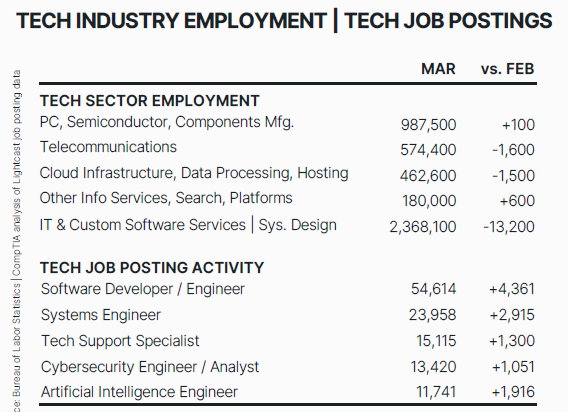
CompTIA’s April 2026 report offers independent evidence that software developer and engineer postings rose in March.
In that report, Software Developer / Engineer postings rose to 54,614 in March 2026, up 4,361 from February. Remote Software Developer / Engineer postings also increased, rising by 1,403 month over month.
To me, that is where the argument starts to feel more convincing.
It is a separate data source telling a similar story.
There is more in that same report that I think students should notice.
The growth is not only about software jobs in the abstract. It is also about changing skill demand. The report shows sharp growth in AI-related hiring intent and continued demand for technical roles tied to data, cloud systems, cybersecurity, and engineering.
That is a useful correction to the common claim that AI is simply wiping out computer science jobs.
What the evidence suggests, at least to me, is something different.
The jobs are still there. The skill mix inside them is shifting.
“AI skills requirements continued their upward trajectory”
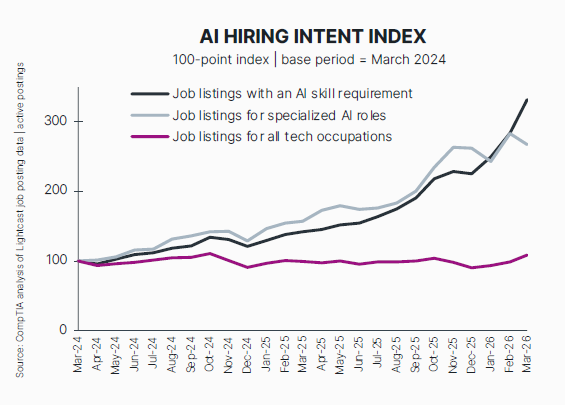
Dice points in a similar direction.
In its February 2026 Tech Jobs Report, Dice reported that tech job postings increased 12% month over month in January 2026. The report also noted that AI skill requirements appeared in 58% of U.S. tech job postings, up from 51% the month before, and up 108% from January 2025.
That does not mean every software professional needs to become a machine learning researcher.
But it does mean AI is moving from the margins toward the center of technical work.
If you are studying computer science right now, one thing to keep in mind is that AI is increasingly showing up as part of the expected toolkit. That can mean machine learning. It can mean data science. It can mean working with LLMs and natural language processing. It can also mean understanding how to build systems around AI tools rather than simply calling an API.
I would give natural language processing special attention here, because transformers and large language models sit so close to the center of current AI development.
“The disruption is happening at the level of skills.”
That was one of the main points in my earlier post, Is Computer Science Dead in 2026?, and I still think it holds up.
The job titles often stay familiar. Software engineer. Developer. Analyst. Data engineer.
But the expectations inside those roles change.
That shift matters.
Students still need the foundations of computer science. At the same time, they need to be paying attention to where employers are putting new emphasis.
In practical terms, I think that means coursework and projects in AI, machine learning, data science, and natural language processing are becoming more valuable.
“Computer science is still a strong path. But the center of gravity is moving.”
I think that is the main thing students should take from all of this.
The current evidence does not support a simple collapse story. Recent data suggests that software-related postings have turned upward. The Citadel chart raised the question, and CompTIA and Dice provide strong outside support.
At the same time, the market is asking for something a little different than it was asking for several years ago.
Core software skills still matter. They matter a lot. But they increasingly sit alongside AI, data, cloud, and systems thinking.
That is one reason I continue to think computer science remains a strong major. If software is becoming more connected to AI tools, data pipelines, cloud platforms, and language technologies, then students who understand those systems will be in a stronger position.
For students deciding whether to major in computer science, that is a useful distinction.
The story here is not disappearance.
It is change.
And I think students are better served when we talk about that change directly.
Final thought
If you have been hearing that computer science is dead, I would be cautious about accepting that story too quickly.
The market cooled. That part was real.
But recent data suggests that postings have begun to rise again, and the deeper shift seems to be toward new skill combinations rather than simple job disappearance.
So if you are in computer science now, or considering it, my suggestion is to build the fundamentals and then add modern layers on top of them. Study algorithms, data structures, systems, and databases. In addition, spend real time with AI, machine learning, data science, and natural language processing.
That combination looks increasingly relevant to me.
Related Articles
If you are thinking about computer science careers, AI, and what students should be learning right now, these pieces connect closely to this discussion.
-
Is Computer Science Dead in 2026?
A broader look at the headlines around AI and computer science jobs, and why the simple collapse story does not hold up very well. -
Programming After Programmers
A response to the New York Times Magazine article on AI and coding, with a focus on why systems thinking and domain knowledge still matter. -
AI for Poets: Why Interdisciplinary Thinkers Matter
Why technical skill alone is not the whole story, and why people who combine computing with domain knowledge may become even more valuable. -
Career Change into Computer Science
A practical look at what it takes to move into software and build a strong foundation in the field. -
What You Learn in Computer Science
An overview of the core ideas behind software systems, and why those ideas still matter in an AI-heavy environment.