CSPB Career Changers: How Alumni Move Into Computing
One of the most important questions for prospective CSPB students is not just where alumni end up.
It is where they started.
CSPB is CU Boulder’s online post-baccalaureate B.S. in Applied Computer Science. Many students enter the program after already completing a first degree and spending time in another field. So the career-change question matters.
Are alumni mostly people who were already in computing?
Or are many of them using CSPB to move into CS from somewhere else?
This LinkedIn-based review is not official CU Boulder placement data. It is a hand-reviewed snapshot based on visible LinkedIn education and work-history information, so it has the usual limitations. Some profiles are incomplete. Some are out of date. Some do not give enough detail to classify confidently.
But the pattern is still useful.
I looked at broader CSPB alumni outcomes in a separate post, including current roles, industries, employers, and geography; this post focuses more specifically on career changers and the paths alumni took into computing: CU Boulder CSPB Alumni Outcomes.
“About 6 in 10 reviewed alumni appear to be career switchers into CS.”
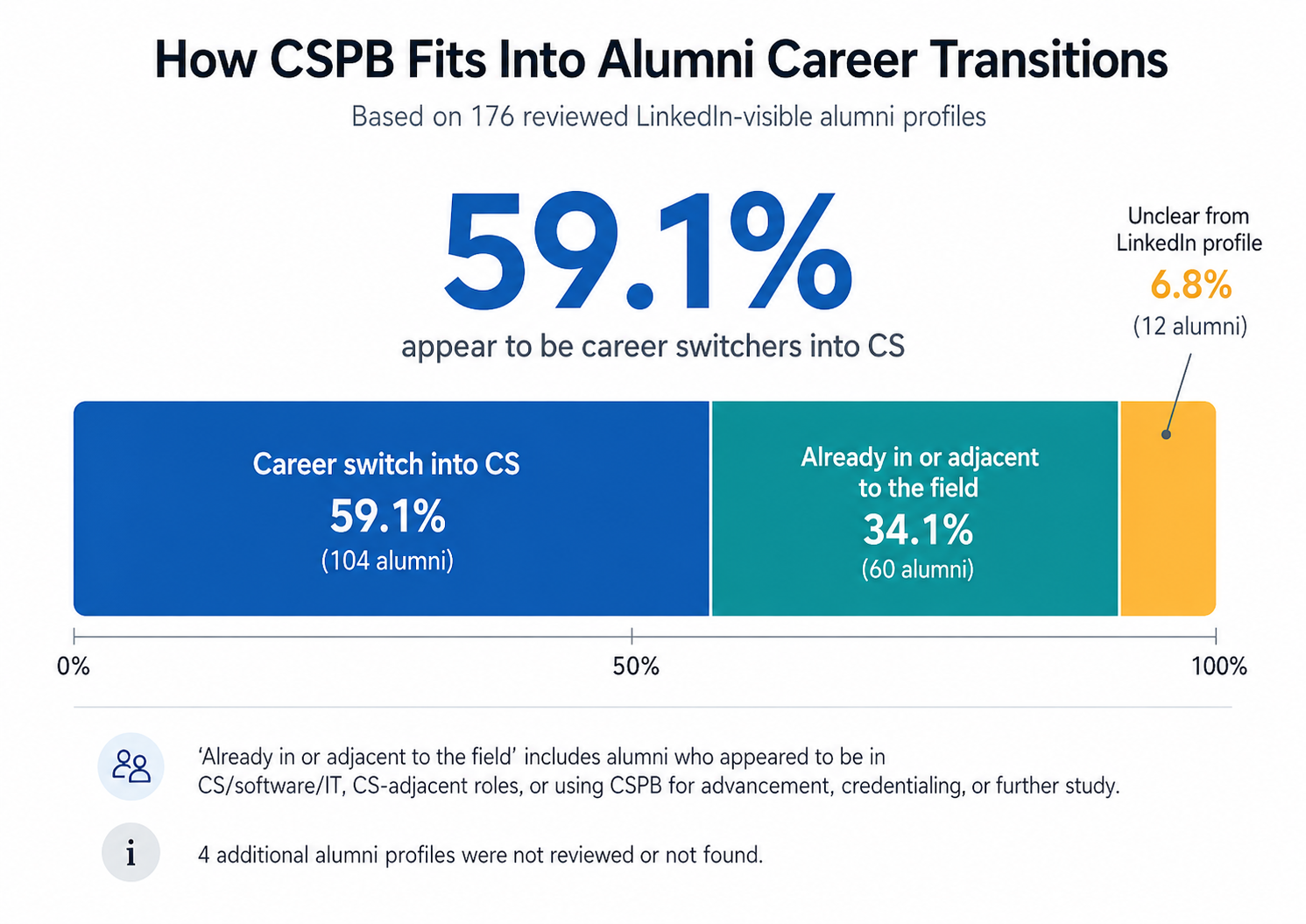
The clearest career-change finding is that 104 of the 176 reviewed LinkedIn profiles appear to represent clear or likely career switches into CS.
That is 59.1% of the reviewed profiles.
Another 60 alumni, or 34.1%, appear to have already been in or adjacent to the field. That includes people who were already in CS, software, IT, CS-adjacent roles, or using CSPB for advancement, credentialing, or further study.
The remaining 12 profiles, or 6.8%, did not provide enough LinkedIn-visible evidence to classify confidently.
So the cautious version is this: in this LinkedIn-based review, about 6 in 10 reviewed alumni appear to be career switchers into CS.
“CSPB alumni come from many first-degree backgrounds.”
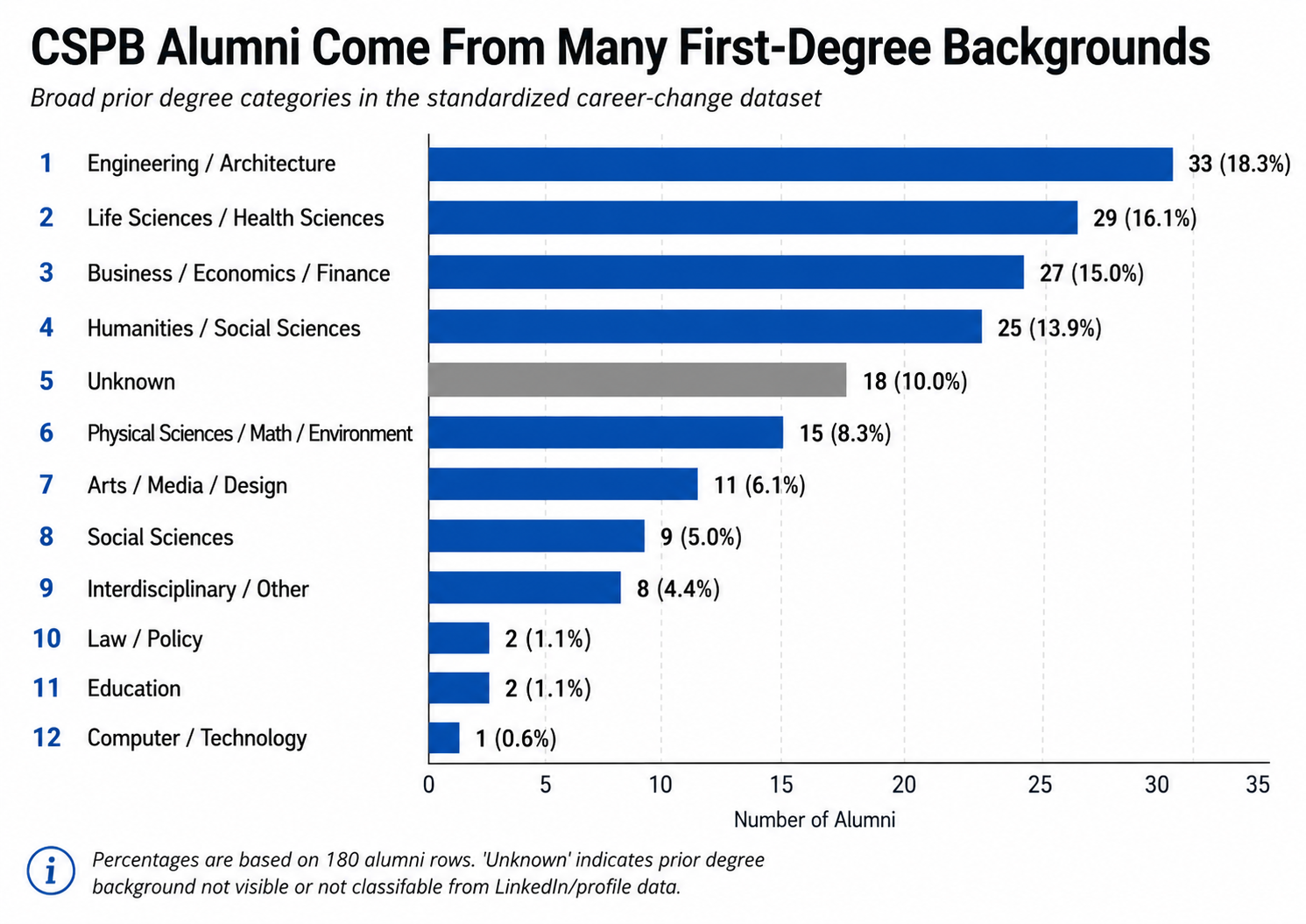
One of the things I find most interesting about CSPB is that students do not arrive from one academic background.
The largest prior-degree category in the dataset is engineering and architecture, but that category represents only 18.3% of alumni rows. Life sciences and health sciences account for 16.1%. Business, economics, and finance account for 15.0%. Humanities and social sciences account for 13.9%.
So there is no single dominant prior academic path into CSPB.
That matters because a post-baccalaureate program is not the same thing as a traditional undergraduate computer science major. Many students arrive with a first degree, prior work experience, and a different way of thinking about problems.
The data suggests that CSPB is serving students who are using computer science as a second layer: a way to redirect a career, deepen a technical path, or combine computing with another domain.
“The individual majors make the range even clearer.”
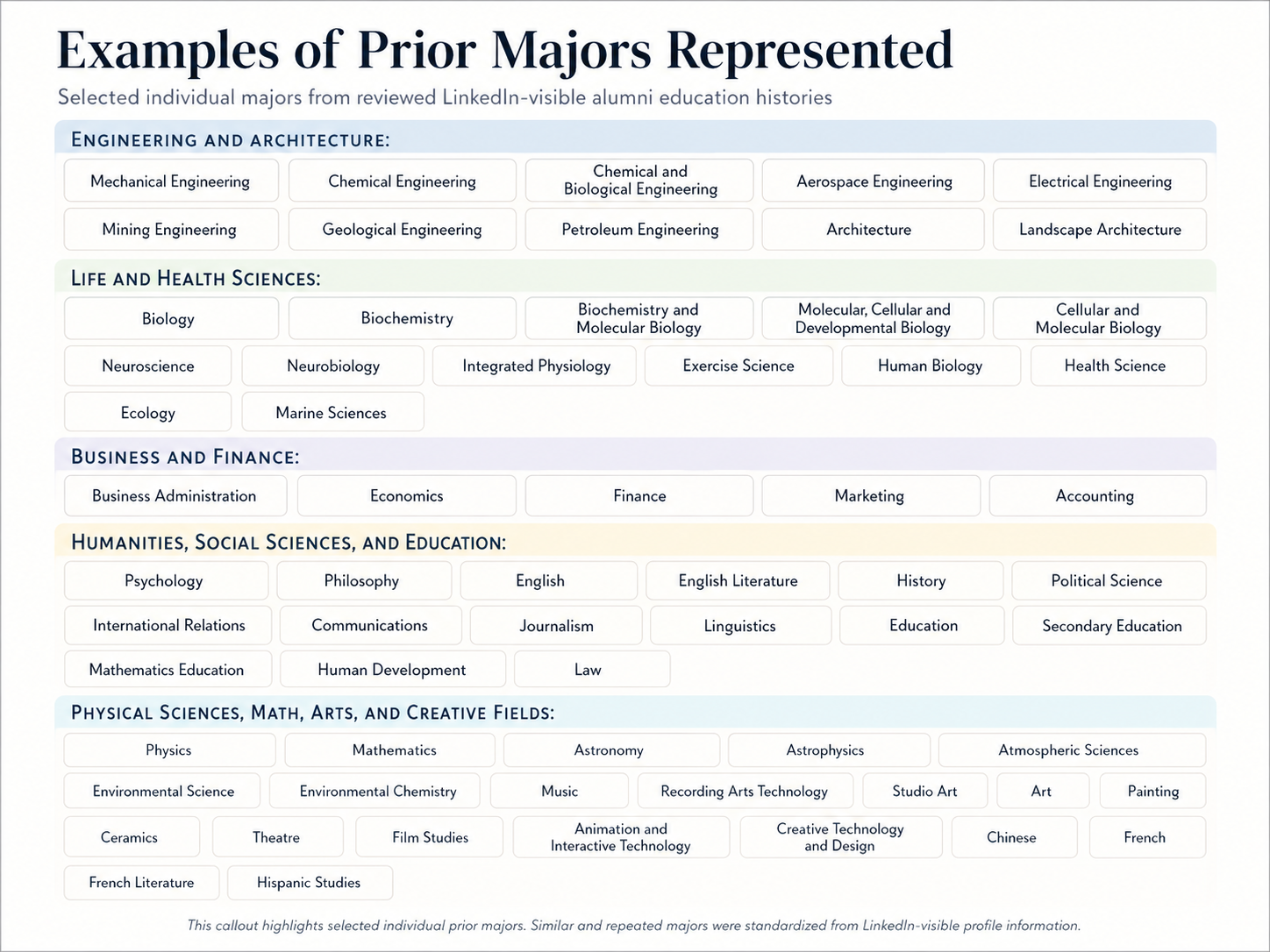
The broad categories are useful, but the individual majors make the point more concrete.
The reviewed profiles include alumni with prior backgrounds in engineering, biology, finance, psychology, philosophy, music, English, journalism, law, physics, architecture, environmental science, studio art, and many other fields.
That is a useful reminder for prospective students.
A prior degree outside CS does not mean someone is out of place in a computer science program. In many cases, that earlier background becomes part of the student’s eventual technical identity.
“CSPB alumni also came from many different professional fields.”
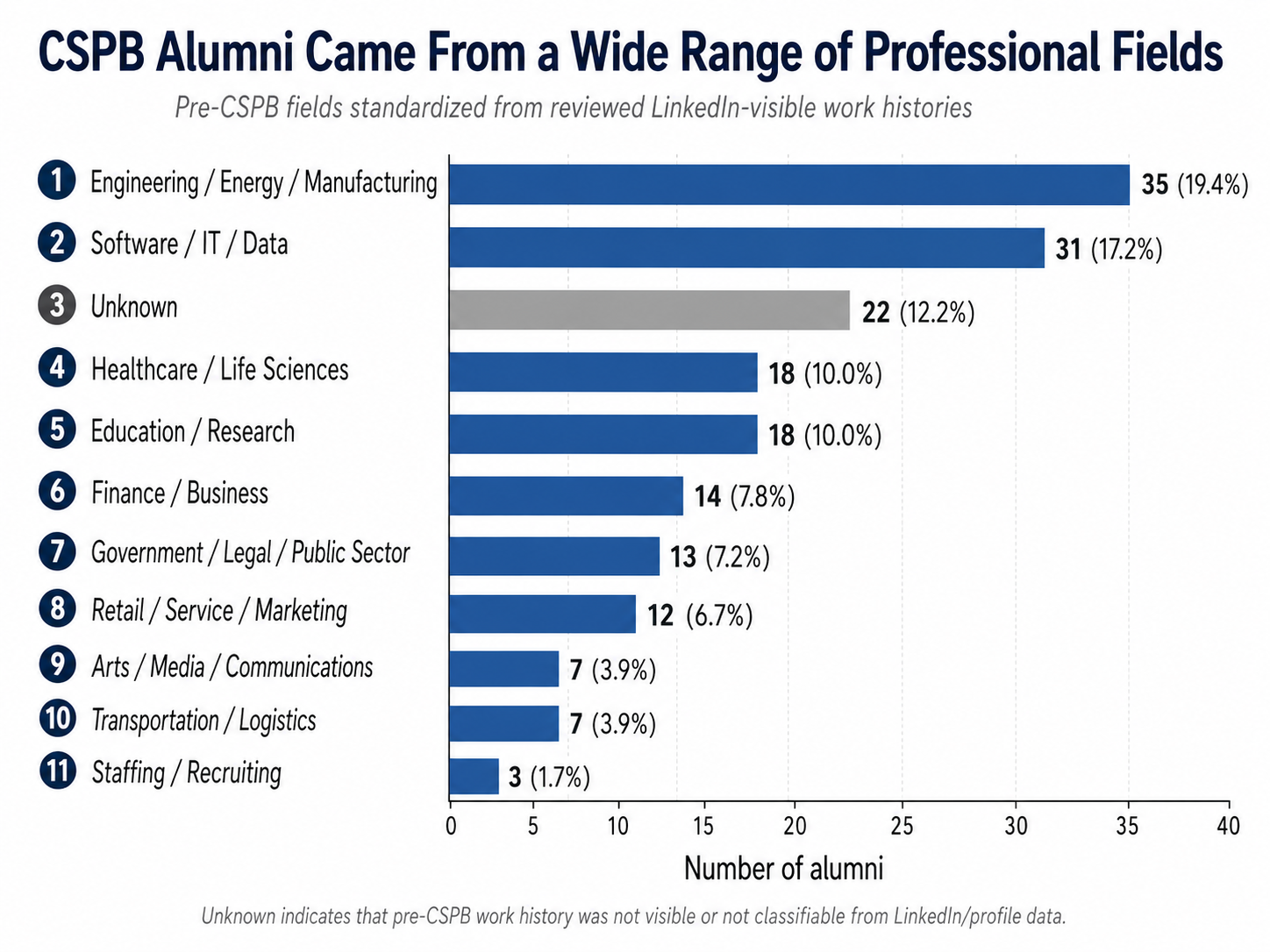
This chart looks at prior work, not just prior degrees.
The largest pre-CSPB category in the reviewed dataset is engineering, energy, and manufacturing, followed by software, IT, and data. After that come healthcare and life sciences, education and research, finance and business, government and public-sector work, retail and marketing, arts and media, transportation and logistics, and recruiting.
So the pattern is broad. CSPB students were not all coming from the same professional world before the program.
That helps explain the career-switch story. Some alumni were already in technical roles. Others were working in fields that were only loosely connected to computing. Still others appear to have been making a much more substantial shift.
In other words, many students seem to bring prior domain experience with them, then use computer science to redirect or extend that experience.
“The first visible step into computing is often software, an internship, or an apprenticeship.”
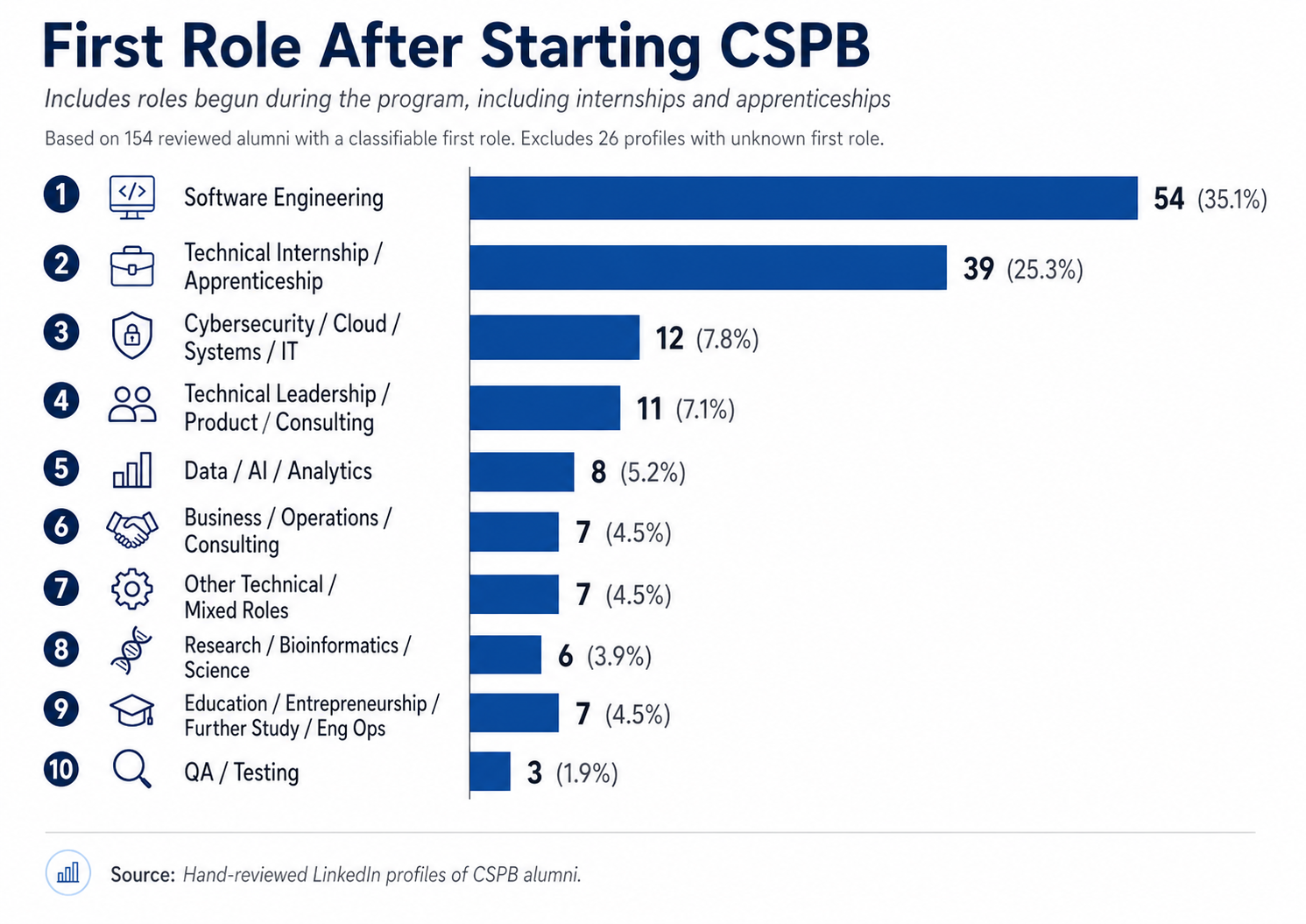
This chart asks what alumni first moved into after starting CSPB, whether during the program or after graduation.
That distinction matters because, for many career changers, the first visible bridge into the field is an internship or apprenticeship rather than a full-time role after graduation.
Among the 154 reviewed alumni with a classifiable first role, software engineering is the largest category at 35.1%. Technical internships and apprenticeships are next at 25.3%.
That is an important result. It suggests that CSPB often functions as a bridge into computing. For many students, the transition shows up first in an internship, apprenticeship, or early technical role, not just in a later full-time job title.
“For many alumni, that first role begins before graduation.”
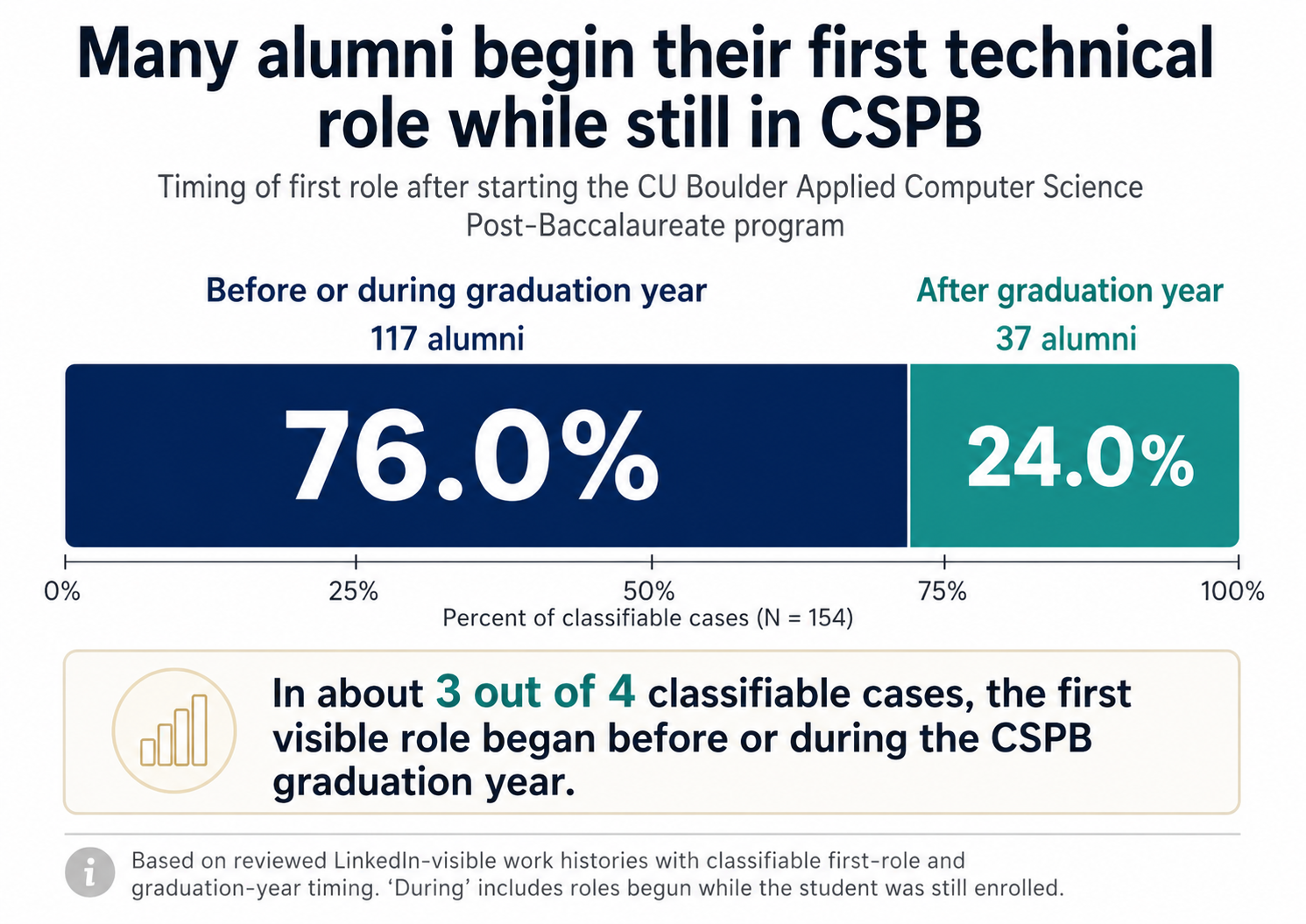
This chart shows when alumni began their first visible technical role after starting CSPB.
In classifiable cases, 76.0% began that first role before or during the CSPB graduation year, while 24.0% began after graduation.
That is an important reminder that, because the program is online and asynchronous, many students are able to begin internships or technical roles while still completing the degree.
“The transition into computing does not happen in just one way.”
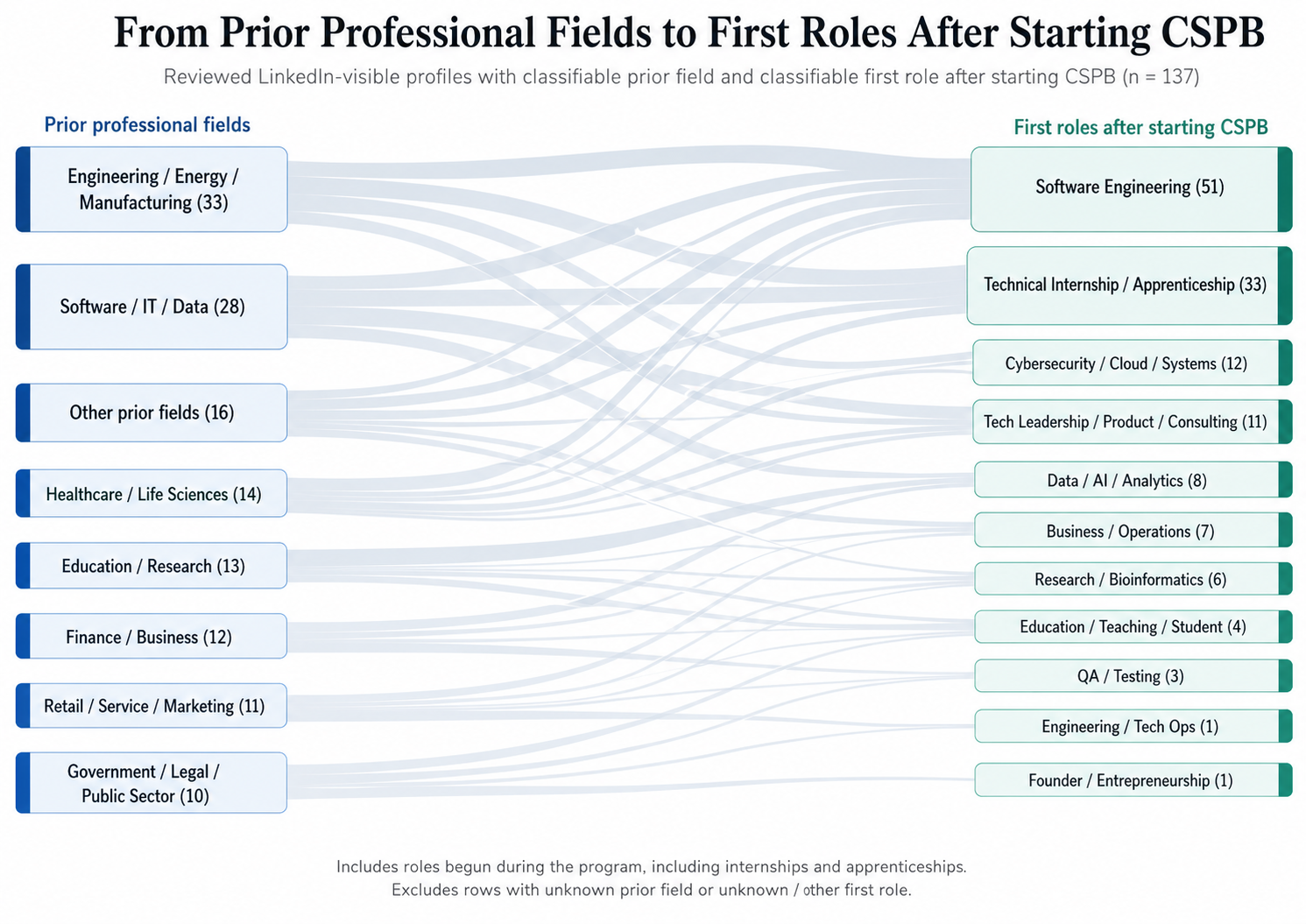
This chart connects alumni’s prior professional fields to their first visible roles after starting CSPB.
What stands out is movement across many different paths. Alumni came from engineering, healthcare, education, finance, government, retail, and other fields, then moved into software engineering, internships, cybersecurity, data, research, consulting, and other technical roles.
The two largest first-role destinations are software engineering and technical internships or apprenticeships. That suggests that, for many students, the transition into computing begins during the program rather than only after graduation.
So the story here is not one pipeline or one destination.
It is multiple routes into computing.
“The first foothold in computing is often not the final destination.”
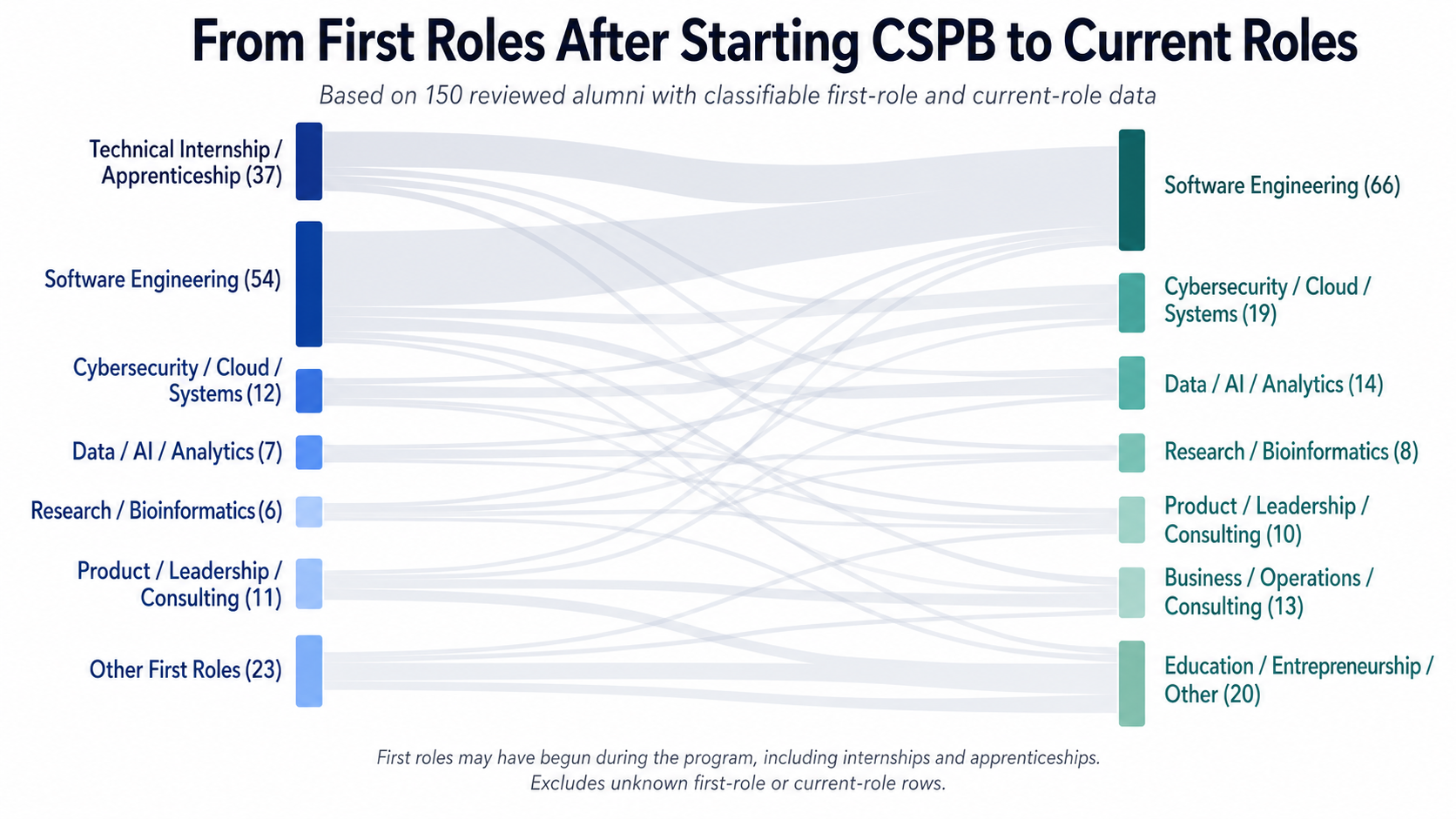
This chart shows how first roles after starting CSPB connect to current roles.
The main pattern is progression. Many alumni begin in internships, apprenticeships, or other early technical roles, then move into software engineering and other established technical paths.
The first foothold in computing is often a bridge, not the endpoint.
“CSPB alumni earned prior degrees across many states and countries.”
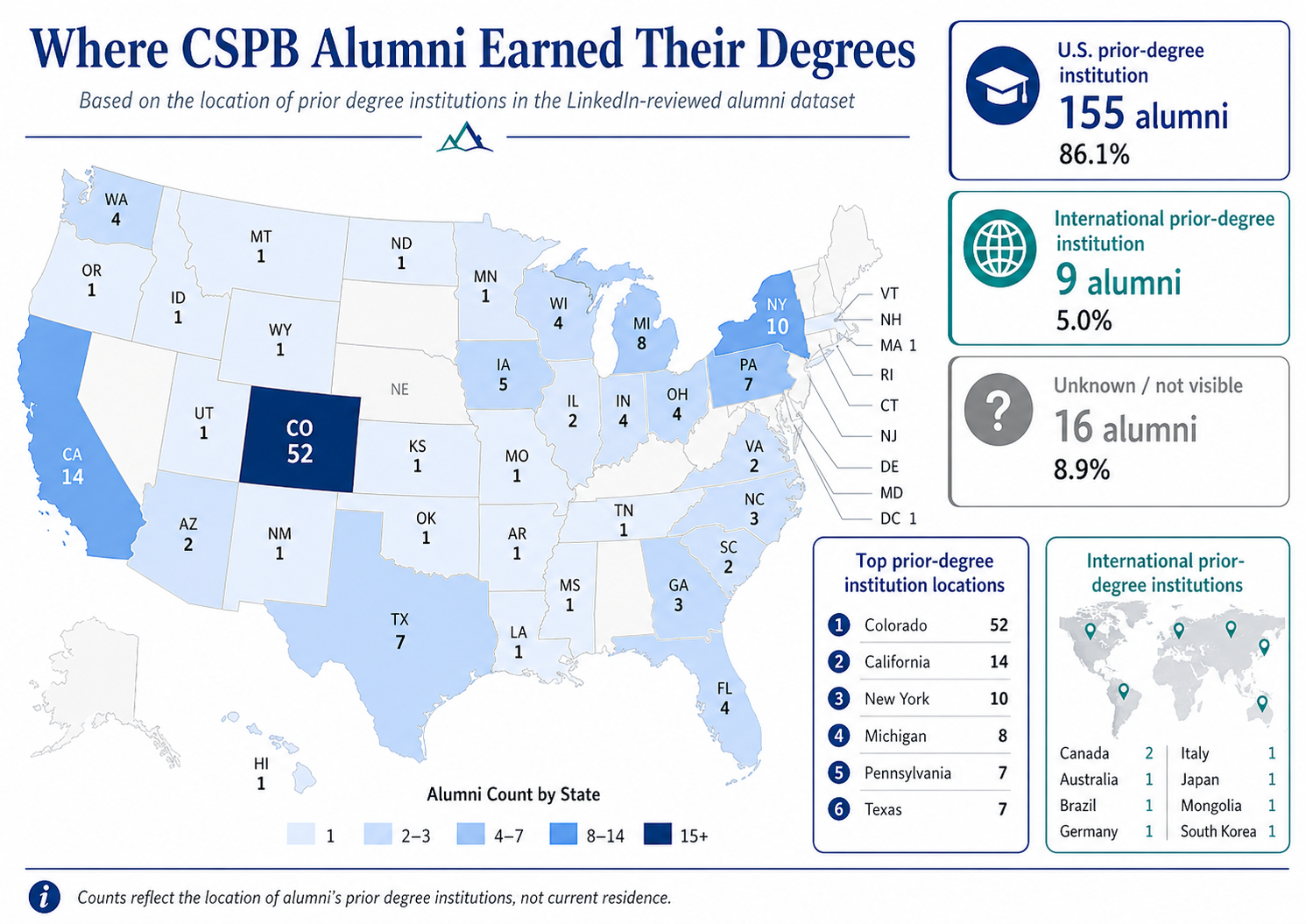
CSPB alumni did not all come from one place before entering the program.
Colorado is the largest single source of prior-degree institutions, but the broader pattern is geographic diversity, with prior degrees spread across many U.S. states and a smaller set of international institutions.
That fits the shape of the program. CSPB has a strong Colorado identity, but it also serves students with varied educational backgrounds from well beyond Colorado.
“The data is useful, but it has limits.”
This is not official university placement data.
It is a hand-reviewed LinkedIn snapshot. It depends on whether alumni had visible profiles, whether those profiles were current, and whether education and work histories were detailed enough to classify.
There was also judgment involved. Prior degrees had to be standardized. Employers and roles had to be interpreted. Some career switches were clear. Others were likely but not certain. A small number remained unclear.
So I would not use this dataset to make overly precise claims.
But I do think it is strong enough to show a useful pattern.
Many CSPB alumni appear to be true career changers. They came from many academic and professional backgrounds. Many began their first technical roles while still in the program. And those first roles often became bridges into later software, systems, data, research, consulting, and other technical paths.
That is the larger story.
CSPB is not just serving one kind of student or producing one kind of outcome.
It is helping students bring prior experience into computing.
Related Reading
-
CU Boulder CSPB Alumni Outcomes
A broader LinkedIn-based look at CSPB alumni roles, industries, employers, and geography. -
Career Change into Computer Science
A practical look at what it takes to move into software and build a strong foundation in the field. -
Computer Science Jobs in 2026: Are Software Engineer Job Postings Rising Again?
A data-driven look at whether software engineering job postings are beginning to recover. -
Is Computer Science Dead in 2026?
A broader response to pessimistic narratives about computer science, AI, and the software job market. -
Programming After Programmers
A discussion of AI, programming, and why systems thinking and domain knowledge still matter.